


Why Traditional Rank Tracking Fails Without Real-Time URL Health Monitoring
Every digital marketing team celebrates when an important landing page climbs into the top three search results. Dashboards turn green, organic traffic projections look promising, and strategy meetings focus on scaling those wins. Yet behind those positive ranking charts, a hidden technical breakdown often quietly drains revenue. A page can hold its position on a third-party ranking report while returning an error to real visitors or silently blocking search engine bots.
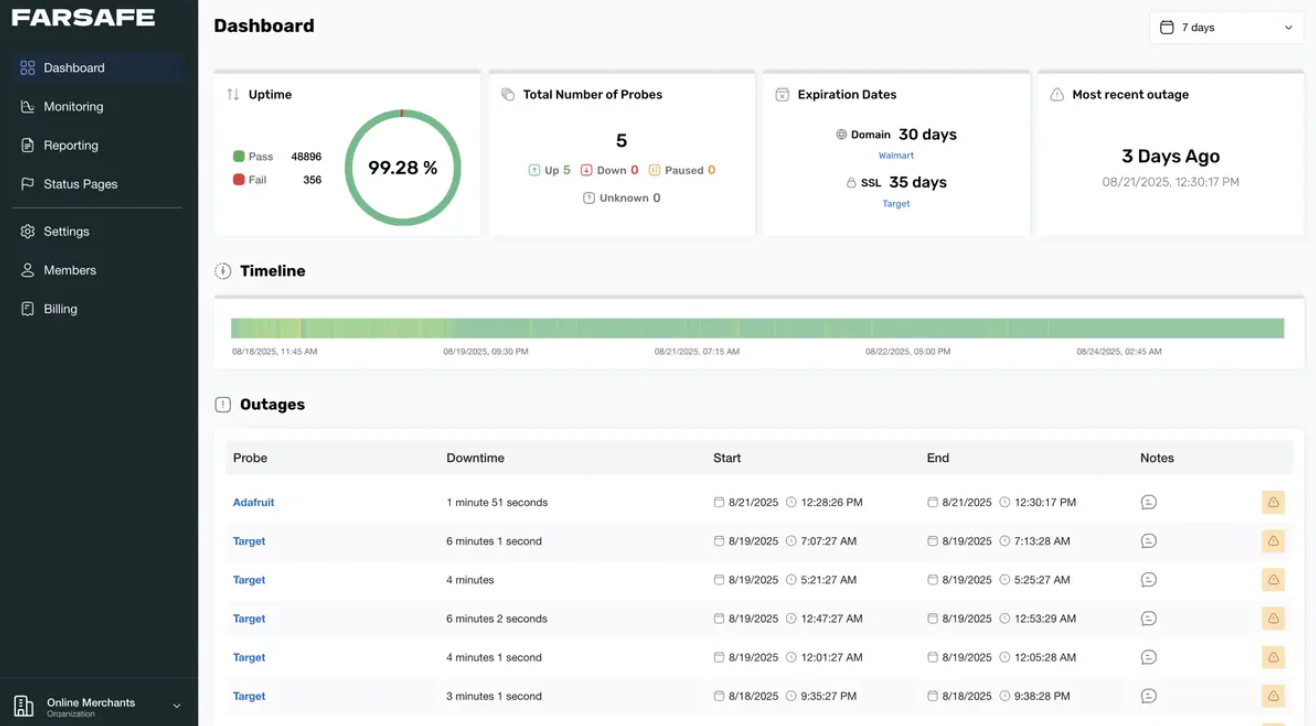
Traditional rank trackers provide a snapshot of keyword visibility, but they do not measure the real-time availability of your infrastructure. When technical failures occur between scheduled checks, rank trackers leave site owners completely in the dark. Relying solely on ranking positions without proactive endpoint validation creates an operational blind spot that hurts user experience and technical search equity. Safeguarding your organic performance requires pairing visibility tracking with a dedicated url monitoring service that alerts you to infrastructure problems the moment they appear.
The Architectural Disconnect Between Rank Trackers and URL Health
To understand why rank trackers miss critical issues, you have to look at how they collect data. Most rank monitoring platforms schedule automated runs once every twenty-four hours or once a week. During these scans, third-party bots scrape search engine results pages from simulated desktop and mobile environments. They check whether your domain appears for a specific keyword query, log the ranking position, and record the cached ranking snippet.
Crucially, the rank tracking bot almost never visits your actual web server. It evaluates Google or Bing search results, not your page headers. If your production server crashes at midnight, runs out of memory, or begins serving a blank white screen, your position on the search engine results page might remain completely unchanged for days.
Search engines operate on their own crawl schedules. As outlined in the Google Search Central documentation on HTTP status codes, Googlebot periodically attempts to fetch and validate documents across the web. If a search crawler visits your URL during an unmonitored server outage, it receives a failure response instead of the intended content. Your rank tracker reports that your keyword is secure, while Googlebot is already logging crawl failures and preparing to drop your page from the index.
Silent Technical Failures That Rank Trackers Never Detect
Websites are complex ecosystems composed of content management systems, database layers, content delivery networks, application firewalls, and third-party APIs. A breakdown in any single component can render a URL inaccessible without triggering a single warning inside standard marketing software.
Intermittent Server Responses and 5xx Gateway Errors
High traffic events, database connection timeouts, and server memory exhaustion frequently cause intermittent 502 Bad Gateway or 503 Service Unavailable errors. These errors often appear intermittently under heavy load. A marketer manually testing the page or reviewing a rank report sees normal performance, while dozens of prospective customers and crawling bots encounter broken screens. Continuous endpoint monitoring tracks responses every sixty seconds, recording intermittent error patterns that human spot checks miss.
Accidental Directives and Soft 404 Pages
Code deployments and plugin updates regularly introduce unintended meta tags or HTTP headers. A developer might push a staging update to production that includes a noindex directive, or a database query failure might cause your CMS to return an empty template with an error notice.
In many cases, the web server continues to return an HTTP 200 OK header even though the page body contains an error message or lacks text entirely. Search engines classify these instances as soft 404 errors. Standard rank checkers do not read page content to confirm whether primary content rendered correctly. Comprehensive URL health tools inspect response bodies and status codes, catching unexpected content drops immediately.
Regional Routing Breakdowns and DNS Failures
Global sites rely heavily on content delivery networks to route requests through edge locations worldwide. When an edge cache misconfigures, a single geographic region may experience complete downtime while the origin server runs normally. Because conventional rank trackers query from static data center IPs, they rarely detect geo-specific outages. A global monitoring network queries endpoints from multiple worldwide checkpoints, alerting engineering teams when users in specific countries cannot load the page.
Silent SSL Certificate Expiration
Security protocols dictate how modern browsers and crawlers treat websites. If an automated SSL certificate renewal fails, web browsers immediately present visitors with aggressive security warnings. Most users bounce instantly, and search engines quickly downgrade sites with untrusted certificates. Rank trackers do not flag upcoming certificate expirations or invalid handshake issues until after organic visibility drops.
The Compounding Impact on Crawl Budget and Organic Rankings
Search engines allocate crawl resources based on host load capacity and algorithmic demand. When Googlebot repeatedly encounters connection timeouts or server errors, it protects host infrastructure by reducing crawl rate. This response directly degrades your crawl budget.
When crawl frequency declines, search engines take longer to discover new content, process internal link changes, and re-evaluate updated pages. If a critical URL returns 5xx errors across multiple crawl attempts, Google begins de-indexing the page to keep broken links out of search results. Recovering lost rankings after an extended outage often requires weeks of technical cleanup, log analysis, and manual submission requests inside Google Search Console.
The financial damage extends to user acquisition channels. Driving paid search campaigns, newsletter traffic, or social media visitors to an intermittently broken page wastes advertising budgets. Every minute a high-ranking URL serves an unhandled error directly reduces conversion rates and damages customer trust.
Core Capabilities of a Modern URL Monitoring Service
Relying on quarterly site audits or manual spot checks is no longer sufficient for serious digital businesses. An effective URL health strategy requires continuous, automated observation of critical conversion paths and organic traffic drivers.
When evaluating an infrastructure solution, look for these foundational features:
- High Frequency Multi-Region Checks: The platform should ping critical URLs at sixty-second intervals across diverse geographical server nodes, eliminating regional false positives and ensuring true global availability.
- Granular Header and Response Validation: Simple ping tests are not enough. The service must verify exact HTTP status codes, check full redirect chains, detect canonical header shifts, and inspect on-page string presence to prevent blank page rendering.
- SSL and DNS Integrity Tracking: Automated alerts for SSL expiration timelines, DNS record modifications, and domain registry statuses keep security incidents from escalating.
- Instant Incident Alert Routing: Outage notices must reach responsible engineers instantly via email, SMS, or operational webhooks so technical teams resolve root causes before search bots penalize the domain.
Frequently Asked Questions
Does a URL monitoring service replace standard SEO auditing tools?
No, URL monitoring and SEO auditing serve complementary functions. SEO auditing platforms analyze keyword rankings, backlinks, on-page content, and overall site architecture on a weekly or monthly basis. A URL monitoring service tracks real-time technical health, server availability, response times, and status codes continuously. Both systems are necessary to run an effective digital strategy.
How quickly does temporary downtime affect search engine rankings?
Very brief outages lasting a few minutes rarely cause immediate rank drops if search engines do not crawl the URL during the failure. However, if micro downtime occurs frequently or if an outage lasts several hours while search bots are active, search engines will quickly remove affected URLs from search results to preserve searcher experience.
What is the difference between simple ping monitoring and URL health monitoring?
Simple ping monitoring sends an ICMP packet to verify that a server is connected to the internet. Deep URL health monitoring evaluates the complete application layer by requesting specific web pages, validating HTTP response headers, verifying SSL certificates, checking redirect paths, and confirming that required page content rendered properly.
Can an automated monitoring platform prevent soft 404 errors?
Yes, advanced URL monitoring platforms inspect the returned page content rather than relying strictly on the server status code. If a page returns an HTTP 200 OK header while displaying an unexpected error string, a short content length, or a blank body, the monitoring tool triggers an incident alert.
How often should high-value URLs and landing pages be checked?
High-traffic landing pages, checkout pages, and core organic revenue drivers should be checked every sixty seconds from multiple geographical locations. Checking at this interval allows your technical team to catch and resolve incidents before search engine crawlers encounter persistent errors.
Protecting Your Search Investment
Ranking on the first page of search results requires substantial time, research, and technical effort. Yet many organizations leave their most valuable organic assets unprotected by assuming that positive ranking reports guarantee a functional website.
Rank tracking reveals market demand, but real-time URL health monitoring protects your infrastructure from silent failures. By incorporating continuous endpoint checks, payload verification, and status monitoring into your operational workflow, you ensure that every visitor and search engine crawler finds a reliable, fast, and fully functioning digital experience. Combine visibility data with robust technical monitoring to safeguard your traffic, preserve your crawl budget, and protect your bottom line.

 English
 French
 Spanish
 Portuguese
 Deutsch
 Turkish
 Dutch
Dutch
 Italiano
 Russian
 Romaian
 Portuguese (Brazil)
 Greek
Greek