


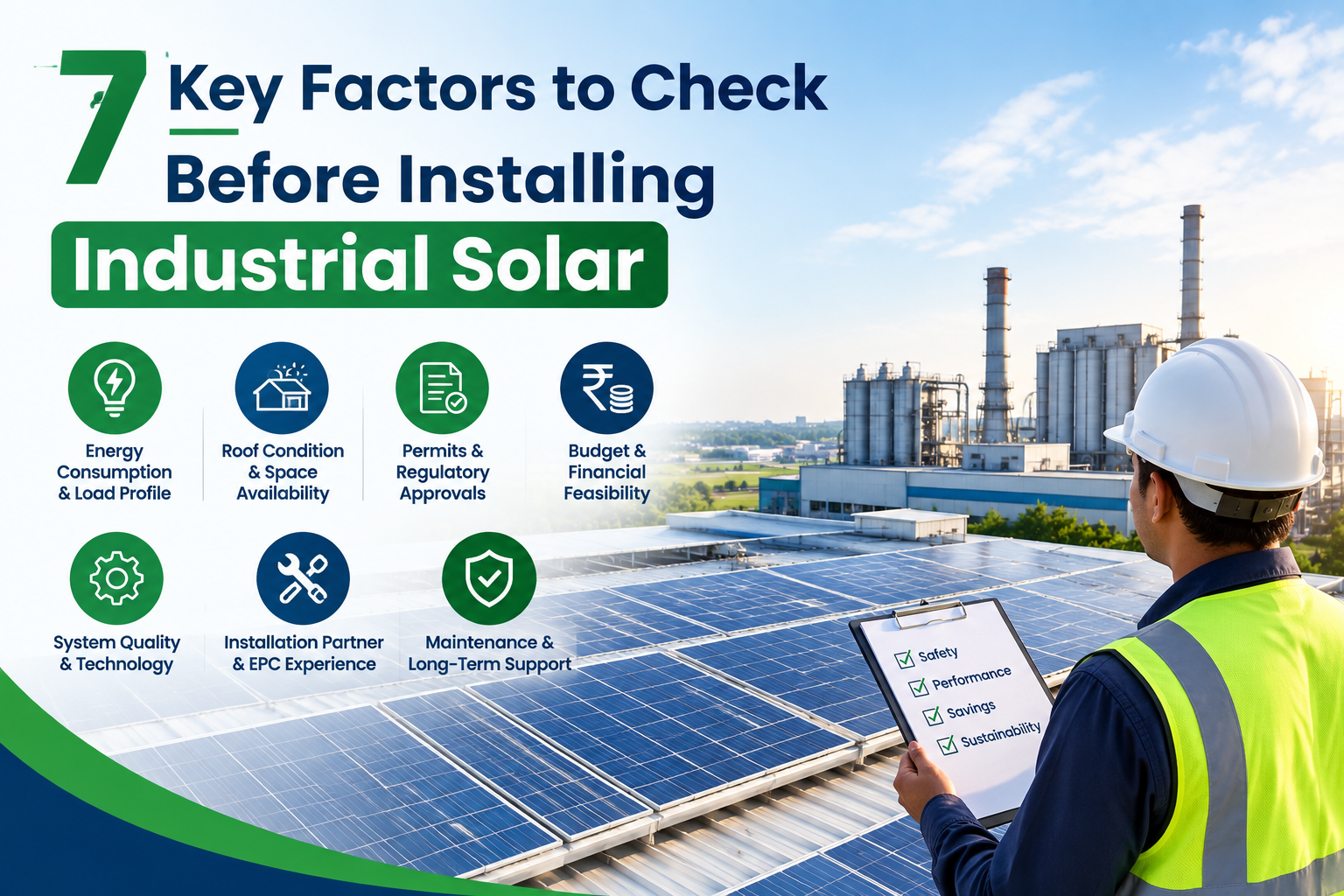
7 Key Factors to Check Before Installing Industrial Solar
For factories, warehouses, manufacturing units, and big commercial facilities, electricity is often one of the biggest operating expenses, and it's not exactly small either. Installing industrial solar can help a business make its own power, ease up on grid energy, and generally sort out long-term energy costs a bit more calmly,even if budgets get tight.
That said, installing a solar plant is a pretty large investment. Picking equipment based only on price can cause headaches later on. Before an industrial solar installation starts, businesses should look over the site, map the energy needs, review equipment quality , estimate the project cost, and confirm the technical requirements.
Below are seven key factors to consider before you invest in an industrial solar system.
1. Check Your Current Energy Consumption
The first step is to figure out how much electricity your facility, sort of actually, uses day to day. Look back at your electricity bills, for at least the last 12 months, and review both monthly and annual consumption.
Then pay attention to peak demand, how much electricity you use during daylight hours, the seasonal swings, and also the operating hours of your facility. All of this, in a pretty practical way, helps you decide the right size for an industrial solar power system.
For instance, a factory that runs mainly when the sun is up can put a big part of its solar output straight to work on site. This can raise the financial upside of the project , not just the “green” part.
Also a solid energy assessment helps prevent companies from getting a system that’s either oversized or undersized. In general the better industrial solar solutions should follow the real energy needs of the building and not some vague guess.
2. Evaluate the Available Roof or Land Area
Solar panels need enuf space, plus decent sunlight exposure too, so before any industrial setup you should really look at what you have , the roof or the ground area. kinda the first step.
For rooftop work, you want to check the roof age and overall structural condition , also the load capacity and how steep the surface is. don’t forget shading, and how much actual room is left for installation. even nearby things like adjacent buildings, water tanks, chimneys, or other structures can cast a lot of shade and it will cut down power production, sometimes more than people expect.
If the rooftop space is tight, then a ground-mounted Industrial solar system can be a smart alternative, as long as there is suitable land. like, proper land that can actually host the panels.
A professional site survey helps spot obstacles, and it guides the best arrangement for the panels. this matters because the usable area you end up with will directly decide the capacity of the industrial solar power system.
3. Choose Reliable Solar Components
The quality of those components really affects the output and the lifetime of your solar plant, like it or not. An industrial solar setup usually comes with solar modules, inverters, mounting structures, cables, protection devices, monitoring systems and yes other electrical bits too.
You shouldnt pick equipment just because its cost is a bit lower at the moment. Instead, you should double check the module specs, the inverter efficiency, the warranty terms, and certifications, how it behaves in heat or cold, plus the expected operating life, too. Otherwise you might end up with something that looks nice on paper but performs weirdly later.
Also, the mounting structure should fit the location, the soil, and the local weather patterns, kind of, so it works right. And it is just as important to choose the right cables, set up proper earthing , arrange lightning protection, and use electrical safety systems that actually make sense.
Good industrial solar solutions rely on parts that can stay working day after day, under strict industrial demands , and with fewer surprises over time.
4. Compare Project Costs and Financial Benefits
Before approving an industrial solar setup, take a step back and work out the whole project cost, not just the panel price like that’s enough. It can sound simple, but in practice the numbers, and the fine details, matter.
Your budget might cover equipment , engineering, installation, mounting structures, electrical work, logistics/transportation, permits approvals, field testing, ongoing monitoring, and maintenance too. Sometimes “minor” items turn into a big chunk, so yeah dont skip them.
It also helps to sort out the expected yearly generation, the electricity savings, when the payback happens, and the long term returns. Depending on how the project get shaped , businesses often look at options like direct ownership, or an arrangement with a third party financing approach, so yeah.
If the financial math is clear, management can see the real value of an Industrial solar investment, not just a headline figure.
When you talk to industrial solar companies, ask them to send a detailed quotation with a transparent breakdown, including equipment, installation scope, warranties, what’s excluded, and what maintenance services are actually included. By comparing those detailed proposals , it becomes easier to spot the best suited option.
5. Check Grid Connection and Approvals
An industrial solar project kind of has to meet the electrical and grid requirements that apply, mostly depending on what, plant size and connection type you pick. With that, you might need different technical approvals, inspections, and also documentation, kind of in a sequence, not always the same.
Before you start the project, make sure you confirm what’s needed for your electricity connection , your metering arrangement , the protection systems, and the utility approvals. It’s easy to overlook one piece and then everything slows down. Also double check how all the documentation should match up, because if there is even a small mismatch, delays happen sooner than you’d think. So check it early, in advance.
For larger plants, the electrical design and safety requirements, they need real careful attention. A qualified project team can help, coordinate the documentation and the technical processes that come up along the way, including the tedious stuff people try to ignore at first.
Also, an experienced industrial solar company should explain the approval process plainly before any work begins. That way the risk of delays during commissioning is much lower, and you’re not stuck guessing later on.
6. Review Installation and Maintenance Plans
A solar plant is expected to last for many years, so the install quality really counts almost as much as picking the right equipment. If the workmanship is not careful, you can end up with loose connections, damaged cables, water leakage, structural problems, or just less energy production than planned, kind of frustrating really.
Before you sign anything ask your chosen provider how the installation process is actually done, what safety procedures they follow, the project timeline, plus how they handle testing, commissioning and the quality checks they run. It helps to be specific, because “we take care of it” is a bit vague.
Even after commissioning there is still the regular maintenance part. Solar panels should be checked and washed only when it starts to become necessary , not just on some random timetable all the time. Also, take a look at the electrical connections, the inverters, the mounting structures and the monitoring system from time to time, so small problems can show up early before they turn into bigger stuff.
So a full industrial solar power system should come with a maintenance plan that’s actually clear, so performance can be followed over time.
When you compare industrial solar companies, don’t only look at the price. Check their technical team, what previous projects they’ve done ,their after-sales support, how they handle warranty claims and if they offer maintenance services or ongoing monitoring. Also, consider how responsive they are when something goes a little off schedule, because that part often makes or break a long term relationship.
7. Select the Right Solar Partner
The company you choose can have a major effect on how well your project actually ends up going. so do not just pick a provider based on the lowest quotation, like, that’s it and nothing else, ok?
Take a look at the company experience with factories, warehouses , production halls and other big scale builds. Ask for references too, even if it feels a bit repetitive, and request project details, technical specifications, warranty terms, plus what kind of service commitments they can realistically offer in practice. Also check how they handled similar installations, and don’t forget to get the real scope, before you move forward, okay.
A trustworthy provider should really grasp your electricity usage, the conditions on site , the technical needs, and the business aims you have, before they even start tossing around recommendations about a system.
The right partner can deliver full industrial solar solutions from site assessment , and system design through installation and commissioning, and then into monitoring, plus ongoing maintenance.
Before you sign anything, i just want you to confirm the scope of work is documented pretty clearly. Also check the equipment brands, the system capacity, what we actually expect for generation, the project timeline, the payment terms , warranties, and , most important, who is exactly responsible for maintenance.
Final Thoughts
An industrial solar project can bring steady long-term value for factories and other high-energy businesses, but it really needs careful planning you know. From looking at electricity consumption, and then checking site conditions, all the way to choosing the right equipment and reviewing the financial returns, each small step can swing the final output of the plant.
In general, a well planned industrial solar setup should line up with its size to real energy needs, and it should be put together with proper equipment plus the safety measures that are needed too. And honestly, linking up with experienced industrial solar companies can make planning, permitting, installation, and ongoing maintenance feel a lot less complicated, even when the timelines get tight, or kind of rushed.

 English
 Arabic
 French
 Spanish
 Portuguese
 Deutsch
 Turkish
 Dutch
Dutch
 Italiano
 Romaian
 Portuguese (Brazil)
 Greek
Greek