


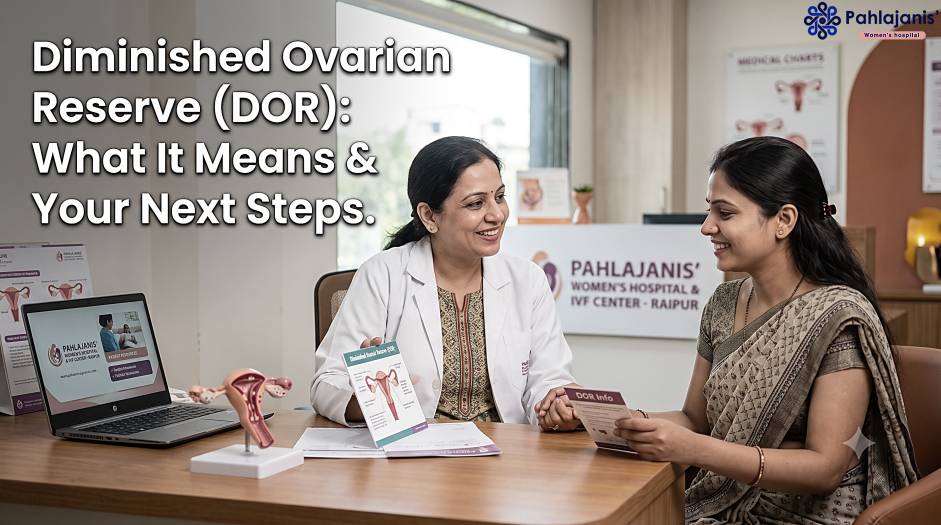
Diminished Ovarian Reserve (DOR): Causes & What It Means for Your Fertility
Hearing "diminished ovarian reserve" for the first time can feel like the ground shifting under you. But a low number on a lab report is information, not a verdict. DOR is far more common than most women realize, and it does not mean your fertility journey is over.
What Is Diminished Ovarian Reserve?
DOR means your ovaries have fewer eggs left than expected for your age, or the remaining eggs respond less well to fertility hormones. You're born with all the eggs you'll ever have, and that number naturally drops every year. DOR simply means your "balance" is lower than typical, not that you have zero eggs left.
How Common Is It?
A large 2023 clinical study of over 13,000 women found an overall DOR prevalence of 37.2%, meaning more than 1 in 3 women tested had some degree of reduced reserve. Among women seeking fertility treatment, prevalence ranges from 6% to 64% depending on age. Importantly, DOR is now appearing in younger women more often than before, so it's no longer just a concern for women over 40.
Read more about Diminished Ovarian Reserve (DOR) - https://www.pahlajanis.com/blog/diminished-ovarian-reserve-dor
What Causes DOR?
DOR usually results from a combination of factors, not just one:
• Natural aging – the most common cause, especially after 35
• Genetics – conditions like Fragile X premutation or a family history of early menopause
• Medical treatments – chemotherapy, pelvic radiation, or ovarian surgery
• Autoimmune conditions – the immune system mistakenly attacking ovarian tissue
• Infections – certain pelvic infections affecting ovarian function
• Lifestyle factors – smoking is the strongest modifiable risk factor
• Unexplained (idiopathic) – no clear cause found despite normal test results
How Is It Diagnosed?
Doctors typically combine two or three tests: an AMH blood test (the most reliable indicator, doable any day of your cycle), an FSH blood test (usually day 2–3), and an antral follicle count via ultrasound. Guidelines generally define DOR as AMH under 1.0 ng/mL or FSH above 10.0 mIU/mL.
Can You Still Get Pregnant?
Yes. DOR affects egg quantity, not automatically your chance of conceiving. Many women with DOR conceive naturally or through IVF. Interestingly, research shows reduced ovarian reserve doesn't always reduce embryo quality — fewer eggs retrieved doesn't necessarily mean fewer healthy options. Time is the biggest factor in your outcome, so earlier evaluation means more choices.
What You Can Do Right Now
1. Get an AMH test this month — it takes one blood draw
2. Ask for a repeat test if results surprise you
3. See a reproductive endocrinologist, not just a general gynecologist
4. Quit smoking if you smoke
5. Track your cycle for 2–3 months before your appointment
6. Ask about egg freezing if you're not ready for pregnancy yet
7. Seek emotional support if the diagnosis feels overwhelming
Local Access in Chhattisgarh
Women in Raipur, Bilaspur, and Bhilai now have local access to AMH testing and fertility specialists without needing to travel to metro cities. Pahlajanis' Women's Hospital & IVF Center, with over 45 years of experience and centers across Raipur, Bhilai, and Bilaspur, offers AMH testing, fertility evaluation, and advanced ART treatments under one roof.
The Bottom Line
DOR is common, manageable, and countless women with this exact diagnosis have gone on to become mothers. What matters most is not the diagnosis itself, but the steps you take with the time you have.
#DiminishedOvarianReserve #DiminishedOvarianReserveSymptoms #AMHTestforOvarianReserve #LowAMHLevelsFertility #DORVsInfertility #DoesDORAffectIVFSuccessRate

 English
 Arabic
 French
 Spanish
 Portuguese
 Deutsch
 Dutch
Dutch
 Italiano
 Russian
 Romaian
 Portuguese (Brazil)
 Greek
Greek