


Electricity Transmission and Distribution Market Developments and Emerging Opportunities
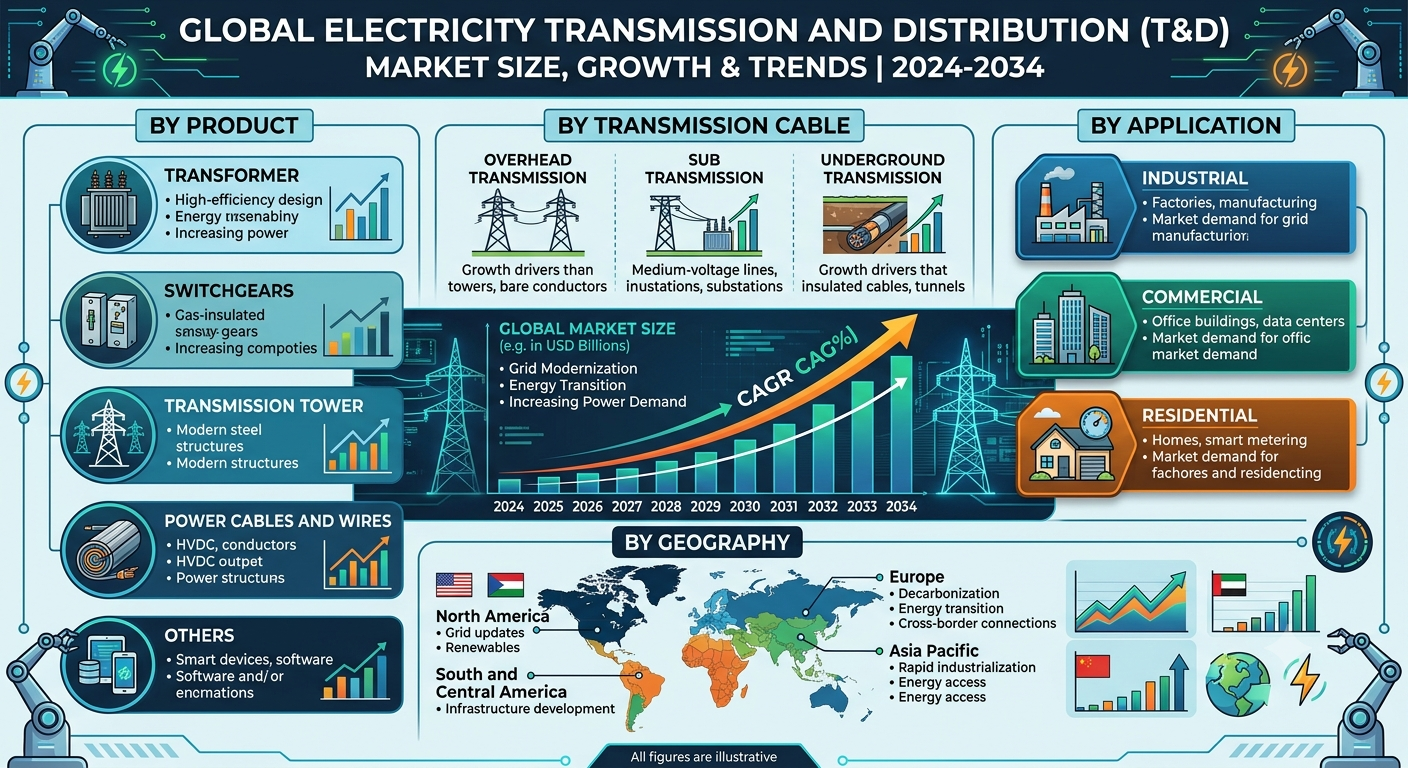
Growing electrification and the expansion of renewable power are driving significant changes in electricity networks across the world. Utilities are increasing investments in transmission corridors, distribution infrastructure, substations, transformers, switchgear, and advanced grid management technologies to accommodate rising demand and changing generation patterns. Data centers, electric vehicles, industrial operations, and commercial facilities are contributing to higher electricity consumption, creating additional pressure on existing networks. Furthermore, aging infrastructure in developed markets and expanding electricity access in emerging economies are supporting long-term investment in network replacement, reinforcement, and expansion.
The global Electricity Transmission and Distribution Market Size was valued at US$373.71 billion in 2025 and is projected to reach US$746.24 billion by 2034, registering a CAGR of 7.99% from 2026 to 2034. The addressable market is estimated at US$5,037.49 billion during 2026–2034, indicating significant long-term opportunities across grid infrastructure development, network expansion, equipment modernization, and power system upgrades. Increasing investment in resilient electricity networks is expected to remain a major contributor to industry growth.
Download Sample PDF Link: https://www.theinsightpartners.com/sample/TIPRE00015652
Market Report Drivers
Grid Modernization and Aging Infrastructure
One of the key drivers is the need to modernize aging transmission and distribution infrastructure. Electricity networks in several developed regions contain equipment that has operated for decades and requires replacement, refurbishment, or capacity upgrades. Utilities are increasingly deploying advanced transformers, high-voltage equipment, digital substations, monitoring systems, automated distribution technologies, and upgraded transmission lines. These investments help improve network efficiency, reduce outage risks, manage power flows, and support increasing electricity demand.
Rising Electricity Demand
Growing electricity consumption across residential, commercial, industrial, and infrastructure applications is creating additional requirements for transmission and distribution capacity. Data centers, semiconductor manufacturing facilities, electric vehicle charging networks, industrial automation, and large commercial developments are contributing to higher and more variable electricity loads. The expansion of these applications requires utilities to strengthen grid capacity and improve network flexibility. As electricity demand continues to rise, investments in new substations, transmission corridors, distribution feeders, and grid equipment are expected to increase.
Renewable Energy Integration
The transition toward renewable power generation is another important growth driver. Solar and wind projects are frequently located away from major electricity consumption centers, creating the need for additional transmission capacity to transfer generated power to demand centers. Variable renewable generation also requires more flexible and responsive grid infrastructure. Utilities are therefore investing in transmission expansion, grid interconnections, substations, energy management systems, and distribution upgrades to accommodate distributed and utility-scale renewable generation.
Electrification of Transportation and Industry
The increasing electrification of transportation and industrial processes is placing additional demands on electricity networks. Electric vehicles require charging infrastructure that can increase local electricity loads, particularly in urban and commercial areas. Similarly, industrial electrification and the adoption of electric heating technologies are changing load profiles. Transmission and distribution networks must therefore be expanded and upgraded to provide adequate capacity while maintaining stable and reliable electricity delivery.
Digitalization and Smart Grid Deployment
Digital transformation is creating new opportunities across electricity networks. Utilities are adopting smart meters, sensors, automated switching equipment, remote monitoring platforms, digital substations, distribution management systems, and advanced analytics. These technologies provide greater visibility into network conditions and enable utilities to identify faults, optimize electricity flows, and improve operational efficiency.
Smart grid deployment also supports the integration of distributed energy resources such as rooftop solar, battery storage, electric vehicles, and flexible loads. As power systems become more decentralized, digital technologies are expected to become increasingly important for managing two-way electricity flows and maintaining grid stability.
Key Companies
Prominent companies operating across the electricity transmission and distribution ecosystem include ABB Ltd., Siemens AG, Schneider Electric SE, General Electric Company, Hitachi Energy Ltd., Eaton Corporation plc, Mitsubishi Electric Corporation, Toshiba Energy Systems & Solutions Corporation, Prysmian S.p.A., and Nexans S.A. These companies participate in areas such as transformers, switchgear, cables, grid automation, substations, power management systems, and digital grid technologies.
Companies are focusing on technological innovation, product development, grid automation, strategic partnerships, and infrastructure projects to address changing requirements from utilities and industrial customers. The competitive environment is also being influenced by increasing demand for higher-efficiency equipment, digital monitoring, renewable integration, and resilient grid infrastructure.
Future Outlook
The future outlook remains closely linked to electricity demand growth, renewable energy deployment, grid resilience initiatives, and electrification. Utilities are expected to increase investments in transmission corridors, distribution networks, substations, transformers, grid automation, and digital monitoring systems. Government programs supporting renewable power, energy security, infrastructure modernization, and electricity access are also expected to create opportunities for industry participants.
The transition toward decentralized power generation and increasing penetration of battery storage will further influence network planning. Advanced grid management technologies are expected to help utilities manage variable generation, distributed resources, and changing demand patterns. With the global Electricity Transmission and Distribution Market projected to reach US$746.24 billion by 2034, infrastructure modernization and network expansion are expected to remain important areas of investment.
About The Insight Partners
The Insight Partners is a global market research and consulting firm providing actionable intelligence across technology, media, telecommunications, healthcare, semiconductors, industrials, and other industries. Its research combines market analysis, industry expertise, and strategic insights to support organizations in understanding emerging opportunities, competitive developments, and changing industry dynamics.
Contact Us
The Insight Partners
Email: [email protected]
Phone: +1-646-491-9876
Website: https://www.theinsightpartners.com
Related Reports -
Submarine Fiber Cable Market Demand, Share & Growth by 2034
Automotive HVAC Market Size, Growth & Trends by 2034
Offshore Wind Cable Market Size, Growth & Trends by 2034

 English
 Arabic
 French
 Spanish
 Portuguese
 Deutsch
 Turkish
 Italiano
 Russian
 Romaian
 Portuguese (Brazil)
 Greek
Greek