


How Do Volumetric Flasks And Vessels Improve Precision in Chemical Analysis?
Exploring Accurate Solution Preparation, Measurement Techniques and Essential Volumetric Laboratory Practices
Precision is one of the most important requirements in analytical chemistry, where even small measurement differences can influence final results. Volumetric Flasks And Vessels, Volumetric Analysis provide laboratories with specialised equipment designed for accurate liquid measurement and preparation of solutions with known concentrations. These vessels are essential in chemistry, pharmaceutical testing, environmental analysis and research laboratories where reliable quantitative measurements are required.
Unlike general-purpose laboratory containers, volumetric glassware is manufactured with precise calibration standards that help researchers achieve greater accuracy and repeatability during analytical procedures.
What Is Volumetric Analysis?
Volumetric analysis is a quantitative laboratory technique used to determine the concentration of a substance by measuring accurately known volumes of solutions involved in chemical reactions.
The technique commonly involves a solution with a known concentration, often called a standard solution, reacting with a sample containing an unknown concentration.
The volume required to complete the reaction is then used for calculation.
Volumetric analysis is widely applied in:
- Chemical quality control
- Pharmaceutical testing
- Environmental laboratories
- Research chemistry
- Industrial analysis
Because calculations depend on accurate volume measurements, the quality and suitability of laboratory vessels play an important role.
Why Are Volumetric Flasks Different From Regular Containers?
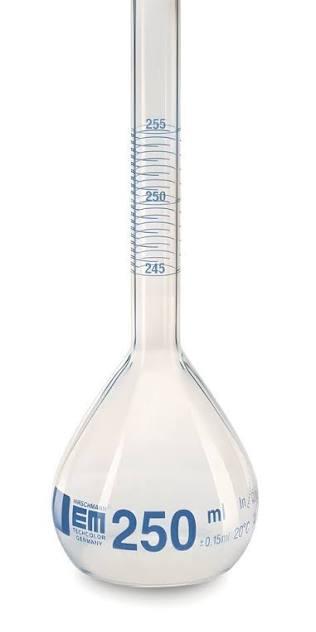
Volumetric flasks are designed specifically for preparing solutions to an exact volume.
Their characteristic features include:
- A narrow neck for accurate reading
- A single calibration mark
- A stable flat base
- A stopper to reduce contamination and evaporation
When a solution reaches the calibration mark, the flask contains a precisely defined volume under specified conditions.
This makes volumetric flasks ideal for preparing:
- Standard solutions
- Calibration solutions
- Diluted samples
- Analytical reagents
The controlled design reduces uncertainty compared with ordinary containers that only provide approximate volume indications.
How Does Accurate Solution Preparation Affect Results?
Many analytical procedures depend on solutions with precisely known concentrations.
If a prepared solution contains more or less solute than expected, calculations based on that solution may produce inaccurate results.
For this reason, researchers carefully control:
- Mass of chemicals used
- Final solution volume
- Temperature conditions
- Mixing procedure
- Transfer accuracy
A volumetric flask provides the final adjustment point where the solution volume can be brought to the exact required level.
This precision supports more reliable experiments and improves consistency between repeated measurements.
The Role of Pipettes in Volumetric Procedures
Preparing accurate solutions often requires transferring a specific amount of liquid before final volume adjustment.
Pipettes (Glass And Single-Use) are designed to transfer measured liquid volumes with improved accuracy.
A common analytical workflow involves transferring a measured volume of concentrated solution using a pipette into a volumetric flask, followed by adding solvent until the calibration mark is reached.
This combination allows researchers to prepare diluted solutions with controlled concentrations.
Proper pipette technique, including correct reading and handling, is essential for maintaining measurement accuracy.
How Do Burettes Support Volumetric Analysis?
Titration is one of the most common applications of volumetric analysis.
During titration, a solution of known concentration is gradually added to another solution until a specific reaction endpoint is reached.
Burettes provide precise control over the volume of liquid delivered during this process.
In a typical titration workflow:
- A volumetric flask prepares the standard solution.
- A pipette transfers the sample solution.
- A burette delivers the titrant accurately.
- Calculations determine the unknown concentration.
Each piece of equipment contributes to the overall accuracy of the analytical method.
Choosing the Correct Measuring Equipment
Not every laboratory measurement requires the same level of precision.
For routine liquid handling, approximate measurements may be sufficient. However, analytical procedures often require equipment specifically designed for accuracy.
Measuring Cylinders are useful when laboratories need controlled volume measurements but do not require the same precision level as volumetric flasks.
Understanding the purpose of each measuring device helps researchers select suitable equipment for every stage of their workflow.
Supporting Chemical Preparation With Beakers
Before a solution is transferred into a volumetric flask, researchers often need to dissolve chemicals or mix components.
Beakers And Erlenmeyer Flasks provide practical containers for these preparation steps.
For example, a solid chemical may first be dissolved in a beaker before the solution is transferred into a volumetric flask for final adjustment.
This approach combines convenience during preparation with accuracy during final measurement.
Why Are Analytical Chemicals Important in Volumetric Work?
The accuracy of volumetric analysis depends not only on equipment but also on the quality of the chemicals being measured.
Analytical Chemicals are designed for laboratory applications where chemical purity and consistency are important.
Using suitable chemical grades helps researchers reduce uncertainty caused by impurities that may affect reactions or calculations.
When high-quality chemicals are combined with precise volumetric equipment, laboratories can create more dependable analytical workflows.
Factors That Influence Volumetric Accuracy
Several factors can affect the accuracy of volumetric measurements.
Temperature Changes
Glass volume and liquid volume can change slightly with temperature variations, which is why measurements are often performed under controlled conditions.
Incorrect Reading of Meniscus
The liquid level should be observed carefully at eye height to avoid measurement errors.
Contaminated Glassware
Residues inside vessels can affect solution composition.
Improper Mixing
Solutions should be thoroughly mixed after preparation to ensure uniform concentration.
Controlling these factors improves reliability and repeatability.
Proper Care of Volumetric Glassware
Although volumetric vessels are designed for accuracy, they require careful maintenance.
Recommended practices include:
- Cleaning after use
- Avoiding scratches or damage
- Inspecting calibration marks
- Storing safely
- Using appropriate cleaning procedures
Damaged or contaminated glassware may affect analytical performance and should be checked regularly.
Applications of Volumetric Analysis
Volumetric techniques are used in many scientific and industrial fields.
Pharmaceutical Quality Control
Used for analysing active ingredients and preparing reference solutions.
Environmental Testing
Supports chemical measurement in water and environmental samples.
Chemical Research
Helps determine concentrations and study reaction behaviour.
Food Analysis
Used for evaluating chemical properties and maintaining quality standards.
Education
Provides fundamental training in analytical chemistry techniques.
Selecting Suitable Volumetric Equipment
The correct equipment depends on:
- Required accuracy
- Solution volume
- Chemical compatibility
- Analytical method
- Laboratory requirements
A volumetric flask is ideal for precise solution preparation, while pipettes and burettes support accurate transfer and reaction measurements.
Choosing the correct combination of tools improves laboratory efficiency and reduces measurement uncertainty.
Improving Accuracy Through Better Laboratory Practices
Volumetric flasks and vessels remain essential components of analytical chemistry because they provide the precision required for accurate solution preparation and quantitative measurements.
By combining calibrated glassware with suitable chemicals, careful handling techniques and appropriate measuring instruments, laboratories can improve reliability and reproducibility.
From routine quality testing to advanced scientific research, volumetric analysis continues to support accurate decision-making and dependable laboratory results across many industries.

 Arabic
 French
 Spanish
 Portuguese
 Deutsch
 Turkish
 Dutch
Dutch
 Italiano
 Russian
 Romaian
 Portuguese (Brazil)
 Greek
Greek