


AI in Genomics Industry: Market Trends, Growth Drivers & Forecast 2026–2034
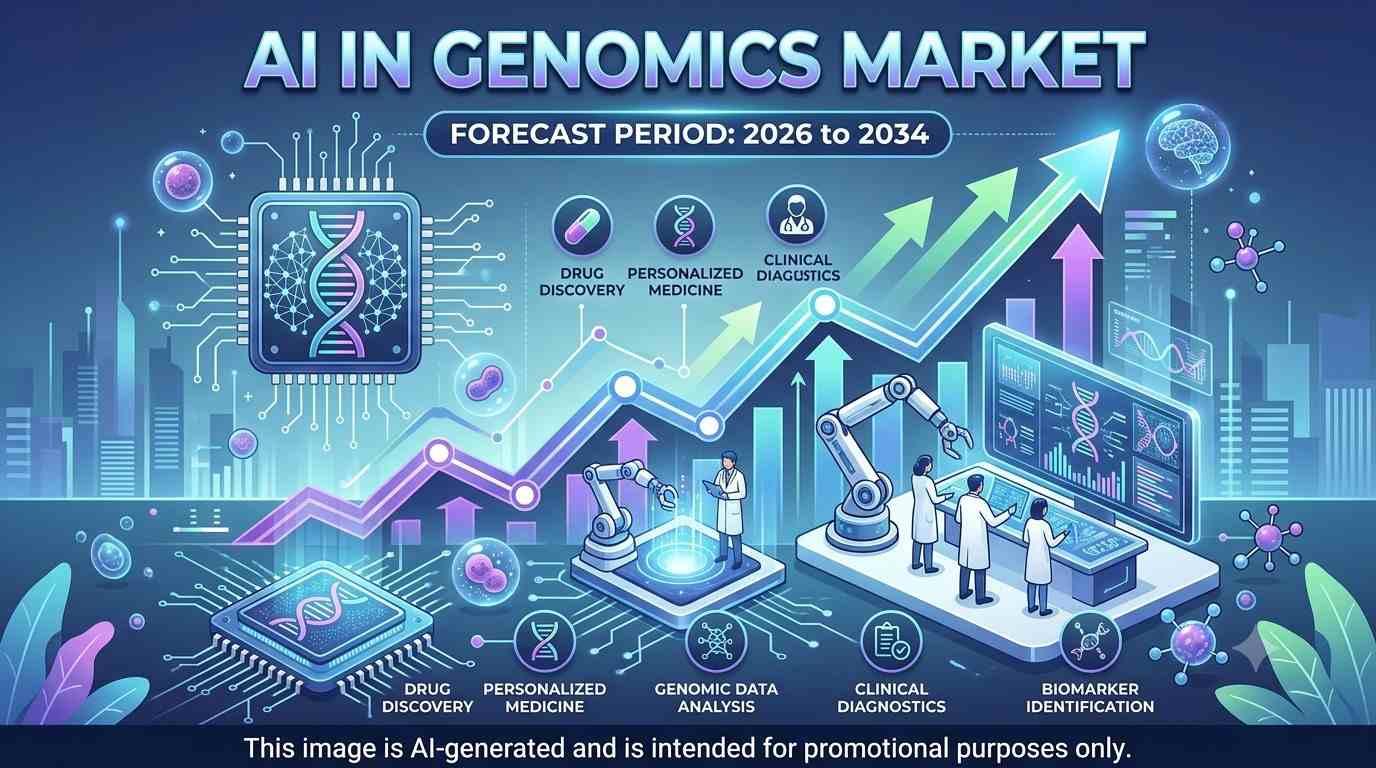
The market is expanding as life sciences organizations, clinical laboratories, software developers, and research institutions transition toward automated platforms that handle immense genomic datasets, lower sequencing interpretation costs, and accelerate therapeutic discovery. Growth is supported by the rapid accumulation of multi-omics data, public and private R&D funding, expanding clinical utility of genome sequencing, and advancements in deep learning algorithms.
The Artificial intelligence in genomics market was valued at US$ 972.34 Million in 2025 and is projected to reach US$ 14928.56 Million by 2034, registering a CAGR of 35.46% during 2026–2034.
What is driving the market?
The demand for precision medicine, the high cost and duration of drug discovery, and the surge in high-throughput genomic data are the principal growth drivers. Research entities and healthcare organizations generate far more sequencing data than human bioinformaticians can manually evaluate, making machine learning tools essential for variant calling, alignment, and biomarker discovery. Pharmaceutical and biotechnology companies are adopting AI models to identify novel gene targets, predict off-target therapeutic effects, and optimize gene-editing platforms like CRISPR.
The transition is moving beyond exploratory research toward clinically integrated predictive diagnostics and targeted oncology workflows. AI providers are investing in foundation models trained on biological structures, multimodal data integration, and automated variant interpretation tools. A shortage of specialized bioinformaticians skilled in AI, strict biological data privacy frameworks, and the need for explainable AI in clinical decision-making remain important constraints.
Which region leads?
North America leads the market, accounting for an estimated 38%–45% share in 2025, supported by early adoption of precision medicine, substantial life sciences R&D investments, and established AI technology infrastructure. The United States presents significant opportunities due to high concentration of genomic research initiatives, private biotechnology venture capital, and supportive digital health policies.
Europe holds an estimated 24%–28% share, driven by national biobank projects, regional precision healthcare initiatives, and expanding diagnostic AI accreditations. Asia Pacific is recognized as the fastest-growing region, registering a projected CAGR of over 42%. Growth in Asia Pacific is propelled by expanding clinical lab networks, rising chronic disease burdens, government-backed genomic mapping projects, and expanding biotech investment across China, Japan, and India.
Which segment leads?
By component, Software leads the market, representing an estimated 41%–53% of revenue, driven by cloud-hosted analytical pipelines, proprietary variant interpretation algorithms, and SaaS biological modeling tools. By technology, Machine Learning (including deep learning) represents the dominant segment, accounting for over 60% of total revenue.
By application, Drug Discovery & Development holds the leading position with over 35% market share, reflecting high adoption among biopharma firms seeking to reduce drug development timelines and failure rates. Precision Medicine and Clinical Diagnostics are identified as high-growth applications, as AI-guided genomic screening tools gain broader adoption in oncology and rare disease identification. Among end users, Pharmaceutical & Biotechnology Companies lead total market expenditure, followed closely by Academic & Research Institutes and Clinical Diagnostic Laboratories.
Which companies are prominent?
The industry identifies NVIDIA Corporation, Illumina, Inc., SOPHiA GENETICS, IBM Corporation, Microsoft Corporation, Deep Genomics, BenevolentAI, Fabric Genomics, Freenome, and Data4Cure as prominent market participants.
These organizations compete across biological foundation models, clinical variant analysis platforms, drug-target discovery engines, cloud infrastructure, and next-generation sequencing integrations. Strategic differentiation increasingly depends on algorithmic accuracy, multimodal data integration capabilities, regulatory approvals (such as IVDR/FDA clearances), cloud security standards, and strategic research partnerships with top-tier pharmaceutical entities. The list reflects key market participants across technology and life sciences rather than a revenue-ranked market-share table.
What is changing in 2026?
The market is shifting from isolated algorithmic research toward clinical-grade, enterprise-scale AI pipelines integrated directly with laboratory instruments and electronic health record (EHR) systems. Platform architectures increasingly focus on federated learning to allow multi-center clinical model training without violating regional patient data sovereignty laws.
Developers are accelerating generative AI models capable of simulating protein-DNA interactions, predicting RNA folding, and synthesizing candidate genetic sequences. Procurement decisions by healthcare systems and biopharma firms are tied to clinical validation, algorithmic transparency, regulatory certification, and seamless interoperability with high-throughput sequencers.
What are the major investment opportunities?
The strongest opportunities lie in AI platforms for multi-omics integration (combining genomic, epigenomic, transcriptomic, and proteomic data), automated clinical variant interpretation, and AI-driven CRISPR edit prediction. Investment in cloud-native bioinformatics pipelines, privacy-preserving machine learning frameworks, and domain-specific AI foundation models offers high growth potential.
Additional opportunities include AI-enhanced liquid biopsy diagnostics, population-scale genomic screening platforms, and specialized hardware accelerators optimized for processing massive biological sequence files. Asia Pacific presents attractive expansion potential due to rising research budgets and large patient cohorts. Investors should prioritize solutions that balance high analytical accuracy with regulatory compliance, clinical workflow integration, and scalable deployment across diverse computing environments.
The Insight Partners provides comprehensive syndicated and tailored market research services in the healthcare, technology, and industrial domains. Renowned for delivering strategic intelligence and practical insights, the firm empowers businesses to remain competitive in ever-evolving global markets.
• Email: [email protected]
• Website: theinsightpartners.com
• Phone: +1-646-491-9876

 English
 French
 Spanish
 Portuguese
 Deutsch
 Turkish
 Dutch
Dutch
 Italiano
 Russian
 Romaian
 Portuguese (Brazil)
 Greek
Greek