


Gojek Clone App: Features, Cost, Business Model & Development Guide
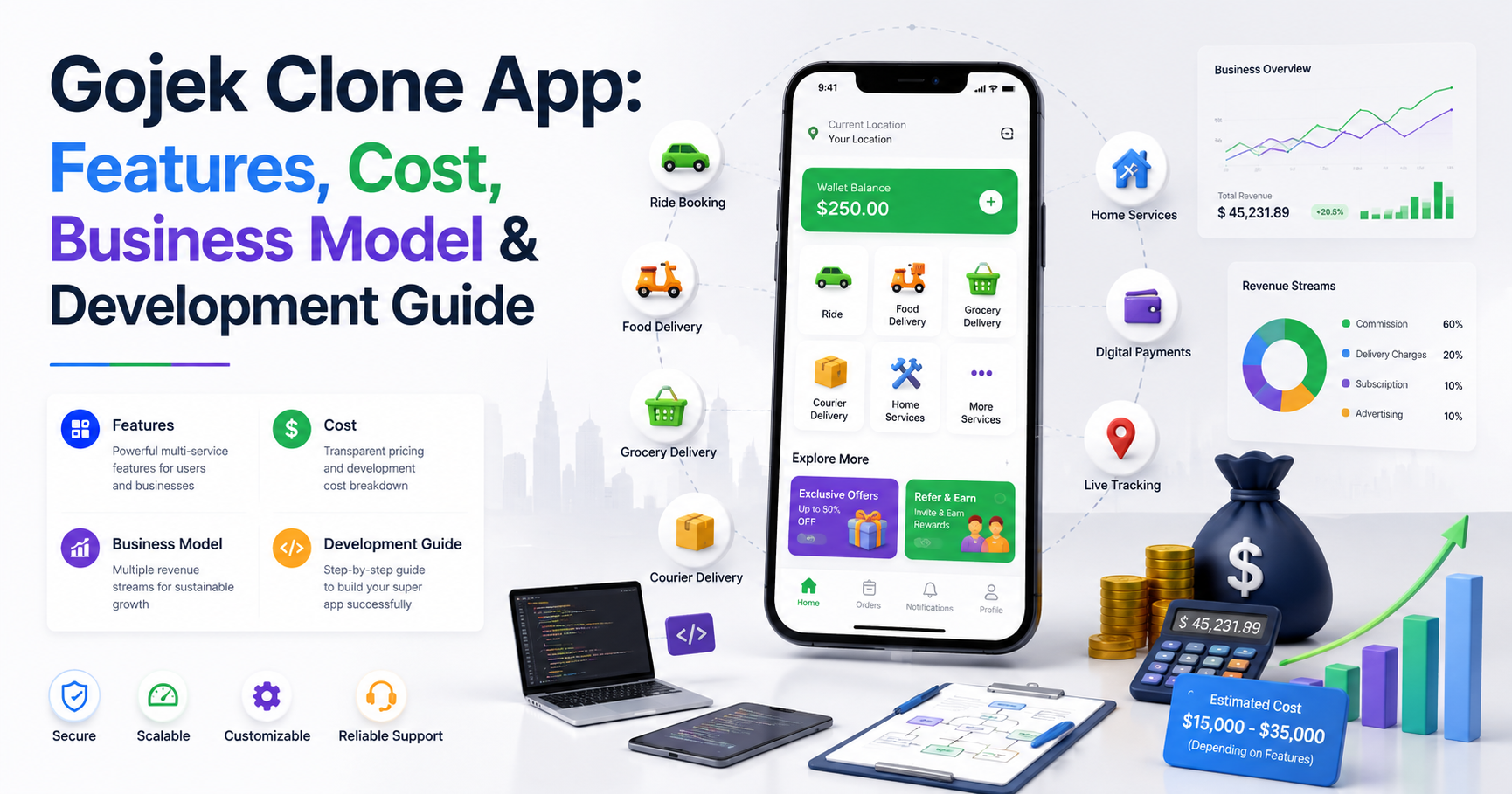
The on-demand economy has changed how people access everyday services. From booking rides and ordering food to grocery delivery and home services, users increasingly prefer getting multiple services through a single mobile application. This growing demand has created opportunities for entrepreneurs to launch multi-service super apps.
A Gojek Clone App provides a ready-made foundation for building an on-demand platform that brings multiple services together in one ecosystem. Instead of developing every feature from scratch, businesses can use a clone-based solution and customize it according to their target market, service categories, and business model.
What Is a Gojek Clone App?
A Gojek Clone App is a multi-service application inspired by the concept of popular super apps such as Gojek. It allows businesses to create a platform where customers can access different on-demand services from one application.
Depending on the business requirements, the platform can include:
-
Ride-hailing and taxi booking
-
Food delivery
-
Grocery delivery
-
Courier and parcel delivery
-
Home cleaning services
-
Beauty and salon services
-
Handyman services
-
Pharmacy delivery
-
Laundry services
The main advantage is that entrepreneurs can launch multiple services under one platform instead of operating separate applications for each service.
How Does a Gojek-Like App Work?
A typical multi-service platform connects customers, service providers, delivery partners, and administrators.
The process generally works like this:
1. Customer selects a service: Users open the app and choose services such as ride booking, food delivery, grocery delivery, or home services.
2. Customer places a request: They provide the required details, select their preferred service, and make a booking or order.
3. Service provider receives the request: The relevant driver, vendor, delivery partner, or professional receives the request.
4. Service is completed: The provider completes the ride, delivery, or requested service.
5. Payment and review: Customers pay through the available payment options and can rate or review the service.
The administrator can manage users, providers, bookings, payments, commissions, promotions, and platform activities from a centralized dashboard.
Key Features of a Gojek Clone App
The success of a multi-service platform depends heavily on its functionality. Some important features include:
Customer App
-
User registration and login
-
Service discovery
-
Location-based search
-
Booking and ordering
-
Real-time tracking
-
Multiple payment options
-
Order history
-
Ratings and reviews
-
Push notifications
-
Offers and promotional coupons
-
In-app support
Driver & Service Provider App
-
Profile management
-
Online/offline availability
-
Booking requests
-
Request acceptance or rejection
-
GPS navigation
-
Real-time location sharing
-
Earnings dashboard
-
Booking history
-
Ratings and reviews
-
Withdrawal management
Vendor Panel
For businesses such as restaurants, grocery stores, and other merchants, the platform can provide:
-
Product or service management
-
Order management
-
Pricing management
-
Inventory management
-
Sales reports
-
Customer information
-
Promotional offers
Admin Panel
The admin dashboard acts as the control center of the platform. It can include:
-
User management
-
Provider management
-
Vendor management
-
Service category management
-
Booking management
-
Commission management
-
Payment management
-
Coupon management
-
Analytics and reports
-
Content management
-
Dispute management
Gojek Clone Business Model
A multi-service platform can generate revenue through several channels. Choosing multiple revenue streams can help reduce dependency on a single service.
Commission
The platform can charge a percentage of every completed booking or order from service providers and vendors.
Delivery Fees
Customers can be charged delivery fees based on distance, order value, location, or service type.
Surge or Dynamic Pricing
For selected services, pricing can be adjusted according to demand, availability, distance, or peak periods.
Advertising
Vendors and service providers can pay for promotional placements, sponsored listings, or advertising campaigns within the platform.
Subscription Plans
Businesses can introduce membership plans that offer customers benefits such as discounted delivery fees, exclusive offers, or priority services.
How Much Does a Gojek Clone App Cost?
The cost of developing a Gojek Clone App depends on several factors, including the number of services, customization requirements, technology stack, integrations, design complexity, and development approach.
A basic platform with limited services will generally require less investment than a highly customized super app containing multiple marketplaces, advanced analytics, real-time tracking, and complex integrations.
Major cost factors include:
-
Number of mobile applications
-
Features and functionality
-
UI/UX customization
-
Backend development
-
Admin dashboard
-
Payment gateway integration
-
Maps and GPS integration
-
Third-party APIs
-
Cloud infrastructure
-
Security requirements
-
Maintenance and updates
Using a ready-made clone solution can potentially reduce development time compared with building the entire platform from scratch.
Gojek Clone App Development Process
A successful development process usually follows several stages.
Step 1: Define the business model
Determine which services you want to provide and how the platform will generate revenue.
Step 2: Identify the target market
Research customer needs, competitors, pricing, and service availability in your target location.
Step 3: Select core features
Prioritize the features required for your initial launch.
Step 4: Customize the platform
Modify branding, UI, service categories, workflows, pricing, and other business-specific elements.
Step 5: Integrate essential technologies
Add payment gateways, maps, notifications, analytics, communication tools, and other required APIs.
Step 6: Test the platform
Perform functional, security, performance, and usability testing before launch.
Step 7: Launch and scale
Launch your platform, monitor user behavior, collect feedback, and gradually add new services.
Is a Gojek Clone App a Good Business Opportunity?
A Gojek-style platform can be attractive for entrepreneurs who want to combine multiple on-demand services under one brand. However, success depends on more than simply launching an application.
Businesses need to focus on service quality, customer acquisition, provider availability, competitive pricing, reliable technology, and retention strategies.
Starting with a smaller number of high-demand services can also make it easier to validate the business model before expanding into additional categories.
Final Thoughts
A Gojek Clone App can provide entrepreneurs with a foundation for entering the growing multi-service and on-demand economy. By combining multiple services into one platform, businesses can create a convenient experience for customers while generating revenue through commissions, fees, subscriptions, and advertising.
Before launching, clearly define your target market, select the right services, validate demand, and prioritize the features that matter most to your users. With the right strategy, technology, and execution, a Gojek-style multi-service platform can be developed into a scalable digital business.

 Arabic
 French
 Spanish
 Portuguese
 Deutsch
 Turkish
 Dutch
Dutch
 Italiano
 Russian
 Romaian
 Portuguese (Brazil)
 Greek
Greek