


How Do Belt-Driven Screw Compressors Transfer Power?
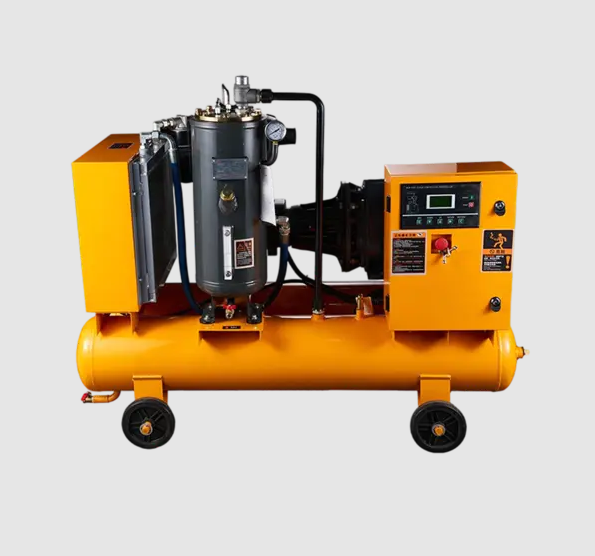
Compressed air rarely gets attention until production stops. Behind many pneumatic tools, filling systems, packaging lines, and automated machines is a compressor quietly turning electrical power into a usable stream of pressurized air. Belt-Driven Screw Compressors take an interesting approach to that job, separating the motor from the air end and connecting the two through a belt transmission system.
The arrangement is easier to understand than it first sounds. The motor produces rotational power, while the screw air end uses that rotation to compress incoming air. A belt and pulley set transfers movement from the motor to the compressor element. Changing pulley dimensions can alter the rotational speed of the air end, giving engineers another variable to consider during system design.
Inside the screw element, two interlocking rotors rotate inside a carefully shaped housing. Air enters the compression chamber and becomes progressively compressed as the rotors turn. The compressed air then moves toward the outlet, where it can enter a receiver tank or downstream pneumatic system.
The belt drive gives Belt-Driven Screw Compressors a distinctive mechanical layout. Motor placement does not have to be directly aligned with the screw element's shaft. This can provide flexibility when arranging components inside the compressor package. It also allows the transmission ratio to be selected according to the desired operating conditions.
Air demand is rarely constant in an industrial workshop. A machine may require bursts of compressed air during one production step and considerably less during another. Compressor control systems can respond to changing demand through methods such as load/unload operation or variable-speed control, depending on the model.
Another interesting detail is the relationship between pressure and airflow. A compressor rated for a particular pressure range does not automatically deliver the same air volume at every operating point. Buyers therefore need to examine both pressure requirements and flow demand rather than looking at motor power alone.
Belt-Driven Screw Compressors can be configured for different industries and installation conditions. Food packaging, textile equipment, machining, assembly lines, and pneumatic automation all use compressed air for different purposes. The required air quality, pressure, flow, and duty pattern can vary considerably between applications.
Noise and vibration are also influenced by the mechanical arrangement. Housing design, belt tension, rotor balance, motor mounting, and isolation components all contribute to the operating behavior of the complete package.
Belt-Driven Screw Compressors are ultimately about controlled power transfer. A motor, belt system, screw element, cooling arrangement, and control system work together to turn electrical energy into compressed air. The belt may seem like a small detail, but it gives this compressor configuration its own engineering character.

 Arabic
 French
 Spanish
 Portuguese
 Deutsch
 Turkish
 Dutch
Dutch
 Italiano
 Russian
 Romaian
 Portuguese (Brazil)
 Greek
Greek