


Passive Fire Protection: Why It's the Most Underestimated Line Item on a Commercial Bid
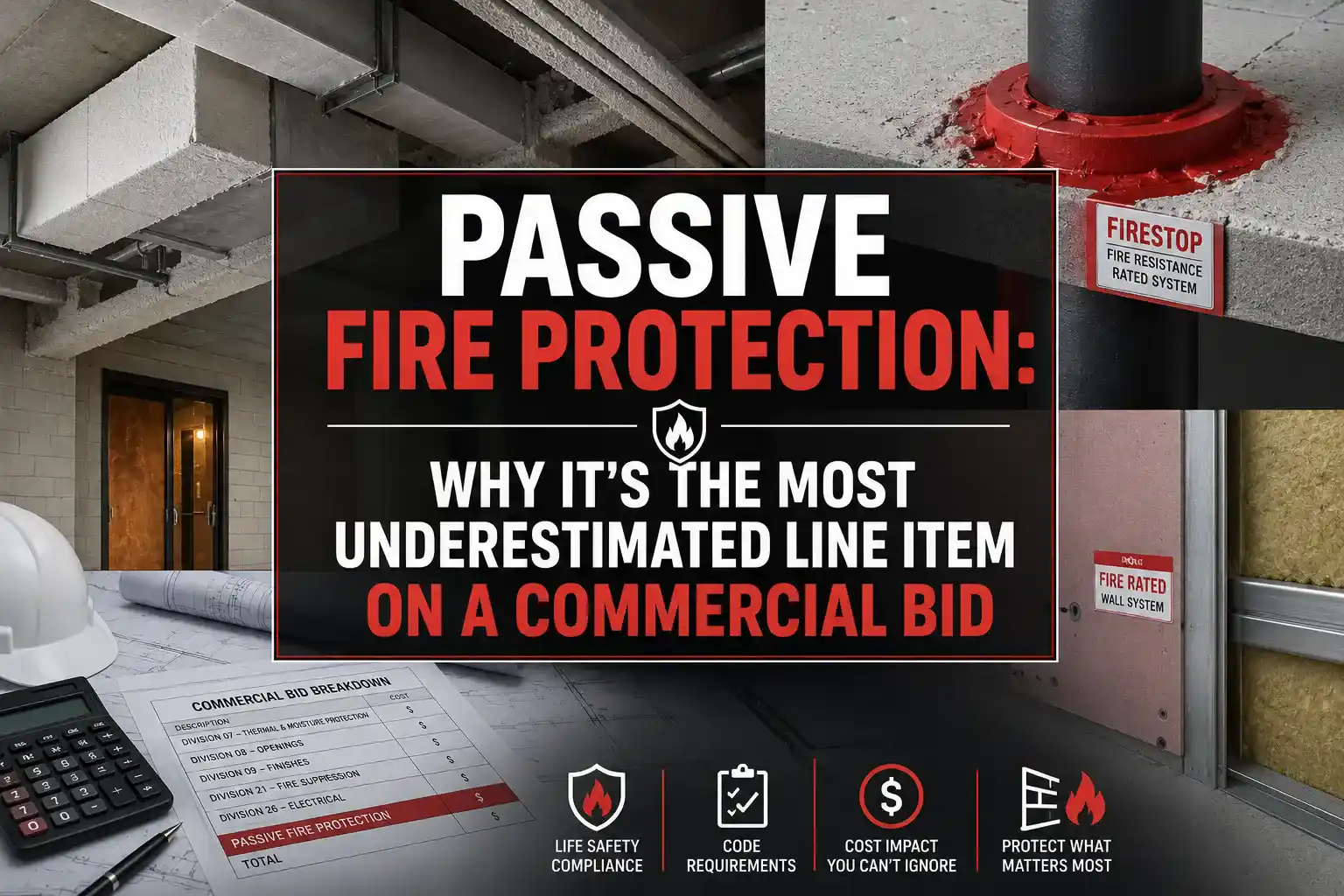
Ask most people outside the construction industry what keeps a building safe in a fire, and they'll picture sprinklers or smoke alarms. Those systems matter, but they're only half the story. The other half that rarely gets attention until something goes wrong during inspection is passive fire protection: the fireproofing, firestopping, and compartmentalization work that quietly slows fire and smoke from spreading through a structure long enough for people to get out safely.
It's also one of the most technically demanding, and most frequently underestimated, scopes on a commercial bid. This piece looks at why passive fire protection deserves far more attention at the estimating stage than it typically gets, and what tends to go wrong when it doesn't.
What Passive Fire Protection Actually Covers
Passive fire protection isn't a single trade or a single material. It's a category of building systems designed to contain fire and smoke within a compartment, rather than actively suppressing flames the way sprinklers do.
Structural Fireproofing
Steel loses strength rapidly when exposed to high heat, which is why structural beams and columns in commercial and industrial buildings are coated or wrapped with fire-resistive materials. The goal is to keep the structural frame stable long enough for occupants to evacuate and firefighters to respond, even as the fire burns above code-rated thresholds.
Firestopping at Penetrations
Every time a pipe, duct, cable tray, or conduit passes through a rated wall or floor, it creates a gap in that fire barrier. Firestopping seals those penetrations with tested assemblies so the wall or floor keeps its original fire-resistance rating instead of becoming a pathway for smoke and flame to travel between floors or compartments.
Compartmentalization Through Walls and Floors
Rated wall and floor assemblies work together as a system, dividing a building into compartments that contain a fire to its area of origin. This is what buys occupants time during an evacuation, and it's a big part of why local codes are so specific about assembly types, materials, and thicknesses.
Why This Scope Gets Underestimated So Often
Passive fire protection sits in an unusual spot on most projects; it's rarely the most visually prominent scope, but it carries some of the highest liability if it's done incorrectly or priced incompletely.
It Requires Cross-Disciplinary Knowledge
Structural fireproofing touches steel design, firestopping touches mechanical and electrical penetrations, and compartmentalization touches architectural wall and floor assemblies. An estimator working this scope needs to understand how all three disciplines intersect, which is a very different skill set than estimating a single trade in isolation.
Penetration Counts Are Easy to Miss
On a large commercial or healthcare project, the number of individual penetrations requiring firestopping can run into the thousands. Missing even a small percentage of those penetrations during takeoff can translate into a meaningful cost gap once the project is underway and change orders start rolling in.
Code Requirements Vary by Jurisdiction and Assembly
Fire resistance ratings aren't one-size-fits-all. The required thickness, material, and tested assembly can change based on the building type, the specific wall or floor assembly, and the local code adopted by the jurisdiction. Estimators who default to a single standard assumption across an entire project risk under-scoping the work.
Waste Factors Get Overlooked
Spray-applied products in particular carry variable waste factors depending on surface complexity, and it's a step that's easy to skip when an estimator is working quickly under deadline pressure. Skipping it tends to show up later as a material shortfall mid-installation.
The Cost of Getting It Wrong
The consequences of an inaccurate passive fire protection estimate rarely stay contained to a single line item. Underestimating structural fireproofing quantities can stall a project when crews run short of material mid-application. Missing penetrations in a firestopping takeoff means costly change orders once the discrepancy surfaces during installation or inspection. And because this scope is directly tied to life-safety compliance, third-party inspectors typically verify that installed systems match approved UL or FM Global designs meaning shortcuts or oversights at the estimating stage tend to surface eventually, often at the worst possible time in the schedule.
Why This Scope Rewards Specialized Estimating
Given how much cross-disciplinary knowledge, code awareness, and attention to detail this work demands, it's not surprising that many general estimators treat it as one of the harder scopes to bid confidently. Getting it right means reading structural, mechanical, and architectural drawings together rather than in isolation, cross-referencing specifications for UL design numbers, and applying labor and waste factors that reflect the real complexity of the installation, not a rough average pulled from a past project.
For contractors and estimating teams who want a deeper, step-by-step breakdown of how this process actually works, this guide on fireproofing estimating and firestopping takeoffs walks through the full takeoff methodology, from scope identification through bid assembly, and is worth bookmarking before your next commercial or industrial bid.
Final Thoughts
Passive fire protection doesn't get the same spotlight as flashy architectural finishes or headline-grabbing structural systems, but it's doing some of the most important work in the building. Treating it as a routine line item, rather than a scope that deserves specialized attention at the estimating stage, is how contractors end up with change orders, schedule delays, or worse. The projects that go smoothly are usually the ones where someone took the time to get this part right from the start.

 Arabic
 French
 Spanish
 Portuguese
 Deutsch
 Turkish
 Dutch
Dutch
 Italiano
 Russian
 Romaian
 Portuguese (Brazil)
 Greek
Greek