


Plasma Fractionation Market Size, Share, Growth, Latest Insights and Forecast 2026-2034
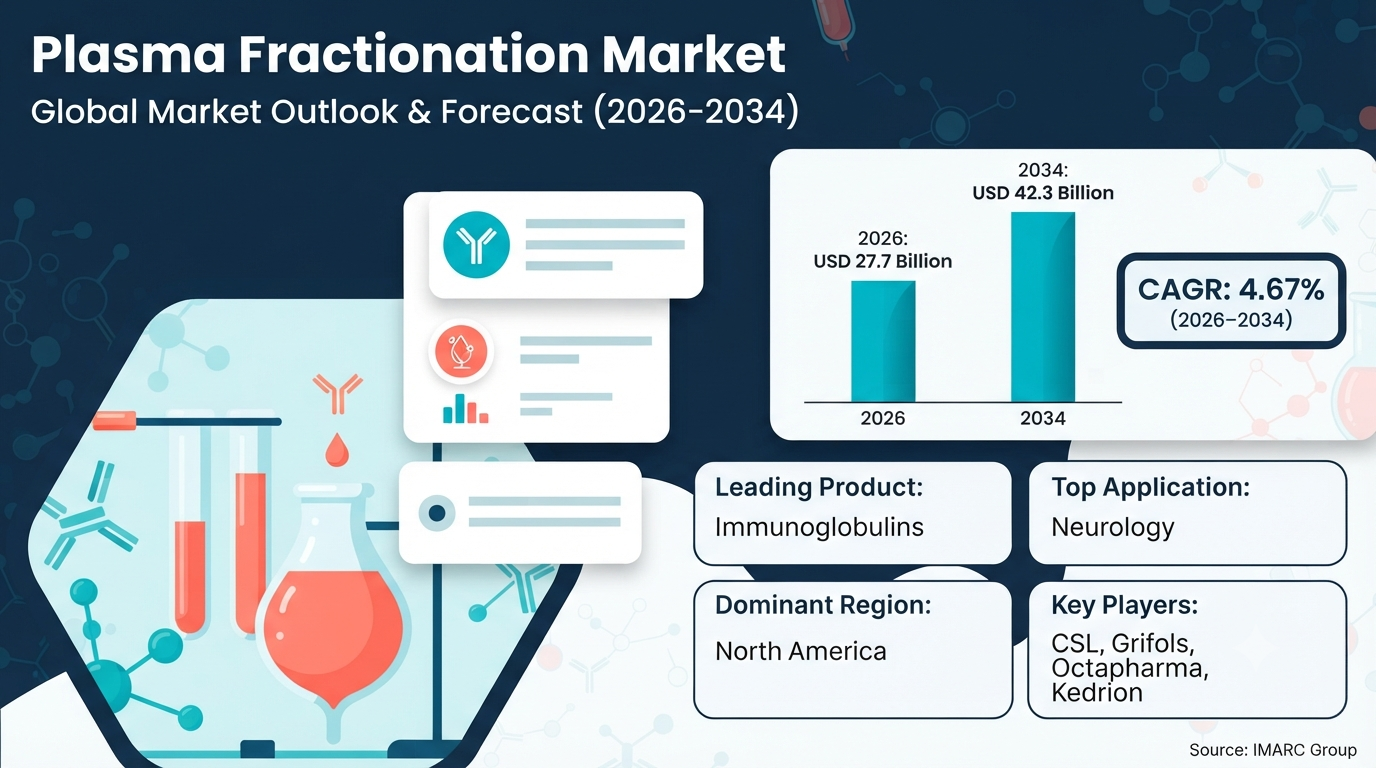
According to IMARC Group, the global plasma fractionation market size reached USD 27.7 Billion in 2025 and is projected to reach USD 42.3 Billion by 2034, expanding at a CAGR of 4.67% during 2026-2034. This steady expansion, detailed in IMARC Group's latest plasma fractionation market report, reflects the rising need to prevent, manage, and treat infections, congenital deficiencies, rare blood disorders, and autoimmune diseases, along with a growing aging population and continual advances in plasma purification technologies. The positive plasma fractionation market growth outlook is further supported by regulatory approvals for plasma-derived products and expanding indications.
Plasma Fractionation Industry Overview
Plasma fractionation is the industrial process of separating pooled human plasma into its individual therapeutic protein components. These fractions are then purified, virally inactivated, and formulated into life-saving medicines. Modern purification methods, including solvent/detergent treatment, pasteurization, nanofiltration, and chromatography (affinity and ion exchange), improve the safety, purity, and yield of the final products, strengthening clinician confidence in plasma-derived therapies.
Plasma-derived products are used across a broad range of clinical areas:
- Immunoglobulins: Replacement therapy for primary and secondary immune deficiencies, such as agammaglobulinemia and hypogammaglobulinemia, and treatment of autoimmune and neurological conditions
- Albumin: Plasma volume expansion and support in critical care and surgical settings
- Coagulation factors (Factor VIII and Factor IX): Management and prevention of bleeding in patients with hemophilia and other rare blood disorders
- Neurology: Immunoglobulin-based therapies for neurological and neuroimmunological disorders
- Immunology and hematology: Treatment of immune deficiencies, congenital deficiencies, and rare blood disorders
Global Plasma Fractionation Market Size & Key Statistics
Below are the key plasma fractionation market size statistics drawn from IMARC Group's comprehensive market analysis:
|
Report Attribute |
Key Statistics |
|
Base Year |
2025 |
|
Historical Period |
2020-2025 |
|
Forecast Period |
2026-2034 |
|
Plasma Fractionation Market Size in 2025 |
USD 27.7 Billion |
|
Market Forecast in 2034 |
USD 42.3 Billion |
|
Market Growth Rate (2026-2034) |
4.67% CAGR |
|
Largest Region |
North America |
|
Leading Product Segment |
Immunoglobulins |
|
Leading Sector Segment |
Private Sector |
|
Leading Application Segment |
Neurology |
|
Leading End-User Segment |
Hospitals and Clinics |
Request for a Sample Report for Detailed Plasma Fractionation Market Report Evaluation: https://www.imarcgroup.com/plasma-fractionation-market/requestsample
Key Market Drivers & Plasma Fractionation Market Trends in 2026
Several powerful forces are shaping plasma fractionation market growth and sustaining demand across global healthcare and biopharmaceutical markets:
1. Rising Need to Treat Infections, Rare Blood Disorders, and Autoimmune Diseases
The growing need to prevent, manage, and treat infections, congenital deficiencies, rare blood disorders, immunologic disorders, and autoimmune diseases is a primary demand driver. Plasma-derived therapies remain a cornerstone of care for these conditions, supporting consistent uptake across patient groups.
2. Expanding Aging Population
According to the World Health Organization (WHO), one in six people worldwide will be aged 60 years or older by 2030, and the global population aged 60 and above is expected to reach about 2.1 billion by 2050. Older adults are more prone to chronic and immune-related conditions, with around 21% of elderly people in India having at least one chronic condition, which is raising demand for plasma-derived therapies.
3. Rising Prevalence of Rare Diseases
As cited by the U.S. Food and Drug Administration (FDA) in December 2022, more than 30 million Americans live with one of over 7,000 rare diseases. Many of these conditions rely on plasma-derived medicines, reinforcing long-term demand for fractionated products.
4. Advances in Plasma Purification Technologies
Solvent/detergent treatment, pasteurization, nanofiltration, and chromatography techniques are improving the safety, purity, and yield of plasma products. These improvements help manufacturers deliver higher-quality therapies while making better use of every liter of donated plasma.
5. Investment in R&D and Processing Technology
Manufacturers are investing in research and development to improve plasma production technology, boost immunoglobulin G (IgG) recovery, and isolate new plasma proteins. Such efforts are widening the therapeutic portfolio and supporting the broader plasma fractionation market report outlook.
6. Regulatory Approvals and Expanded Indications
Regulatory approvals and expanded indications for plasma-derived products are opening new patient populations and geographies. In June 2024, for example, Japan approved Takeda's CUVITRU as replacement therapy for patients aged two and older with agammaglobulinemia or hypogammaglobulinemia.
Key Market Segmentation
By Product
Immunoglobulins — Largest Segment: Immunoglobulins dominate the product segment, supported by their wide use in immune deficiencies, neurological disorders, and autoimmune conditions, and by ongoing efforts to boost IgG recovery.
Albumin: Albumin is widely used for plasma volume support and in critical care and surgical settings.
Coagulation Factor VIII: Used in the management of hemophilia A and related bleeding disorders.
Coagulation Factor IX: Used in the management of hemophilia B and related bleeding disorders.
By Sector
Private Sector — Largest Segment: The private sector leads the market, reflecting the strong presence of commercial plasma collectors and fractionators.
Public Sector: Public-sector and national blood authority programs remain important, particularly for national self-sufficiency in plasma-derived medicines.
By Application
Neurology — Largest Segment: Neurology leads application demand as immunoglobulin-based therapies are increasingly used for neurological and neuroimmunological conditions.
Immunology: Covers immune deficiencies and autoimmune conditions treated with plasma-derived products.
Hematology: Covers bleeding and clotting disorders treated with coagulation factors and related plasma proteins.
Other Applications: Includes additional therapeutic uses of plasma-derived proteins.
By End User
Hospitals and Clinics — Largest Segment: Hospitals and clinics account for the dominant end-user share, given their role in administering infusion-based plasma therapies and treating complex patients.
Clinical Research Laboratories: Use plasma-derived products and proteins for clinical studies and development work.
Academic Institutes: Support research into plasma proteins and new therapeutic applications.
Regional Plasma Fractionation Market Analysis
|
Region |
Key Highlights |
|
North America — Largest |
United States & Canada; advanced healthcare infrastructure, a well-established network of healthcare providers, and a strong base of plasma-derived medicine suppliers |
|
Asia-Pacific |
China, Japan, India, South Korea, Australia, Indonesia & Others; expanding healthcare access, an aging population, and growing demand for plasma-derived therapies |
|
Europe |
Germany, France, United Kingdom, Italy, Spain, Russia & Others; mature healthcare systems and an established plasma-derived medicines industry |
|
Latin America |
Brazil, Mexico & Others; improving access to plasma-derived therapies and rising healthcare investment |
|
Middle East & Africa |
Healthcare modernization and growing demand for specialty plasma-derived medicines |
North America currently dominates the global market, owing to its advanced healthcare infrastructure, a well-established network of healthcare providers, and the strong presence of leading plasma-derived medicine companies. This regional leadership shapes the overall plasma fractionation market size and competitive landscape.
Connect for Detailed Plasma Fractionation Market Report Segmentation Analysis — Speak to an Analyst: https://www.imarcgroup.com/request?type=report&id=5973&flag=C
Challenges and Opportunities
Challenge — Plasma Supply: Ensuring a stable and sufficient supply of plasma remains a key concern for the industry, since fractionation output depends directly on donor collections.
Opportunity — Donor Recruitment: Increasing donor recruitment efforts present a clear opportunity to expand plasma availability and support future plasma fractionation market growth.
Leading Players in the Global Plasma Fractionation Industry
The global plasma fractionation market is competitive, with established plasma-derived medicine and bioprocessing companies investing in capacity expansion, regulatory approvals, and long-term supply agreements. Key companies covered in the IMARC Group report include:
|
Company |
Core Focus |
|
ADMA Biologics Inc. |
Plasma-derived biologics, immune globulin products |
|
Boccard |
Engineering and construction for plasma fractionation facilities |
|
CSL |
Plasma-derived therapies and immunoglobulins |
|
Grifols, S.A. |
Plasma-derived medicines, plasma collection and fractionation |
|
Intas Pharmaceuticals Ltd. |
Pharmaceutical manufacturing and biologics |
|
Kedrion |
Plasma-derived medicinal products |
|
LFB |
Plasma-derived and biotechnology medicines |
|
Octapharma AG |
Plasma-derived protein therapies |
|
PlasmaGen BioSciences Pvt. Ltd. |
Plasma fractionation and plasma-derived products |
|
Sartorius AG |
Bioprocess and purification technologies |
Latest Plasma Fractionation Market Industry Developments
June 2024 — Takeda
Japan approved Takeda's CUVITRU as replacement therapy for patients aged two and older with agammaglobulinemia or hypogammaglobulinemia. In the same month, Takeda expanded its plasma fractionation capacity by up to 2 million liters.
June 2024 — Grifols / Biotest
Biotest, a subsidiary of Grifols, received its first U.S. FDA approval, for an intravenous immunoglobulin (Ig) treatment.
September 2022 — Grifols
Grifols signed a long-term agreement with Canada's national blood authority to increase the country's immunoglobulin self-sufficiency.
March 2021 — BPL / Grifols
BPL sold 25 Grifols plasma facilities in the United States, resulting in an additional one million liters of fractionation capacity.
Frequently Asked Questions (FAQs)
What is the Plasma Fractionation Market Size in 2025?
The global plasma fractionation market reached USD 27.7 Billion in 2025, supported by rising demand for plasma-derived therapies for infections, rare blood disorders, and autoimmune diseases.
What are the key Plasma Fractionation Market Trends shaping the industry?
Key trends include investment in R&D to improve plasma production technology, higher IgG recovery, isolation of new plasma proteins, and continued progress in purification methods.
What is the Plasma Fractionation Market growth forecast through 2034?
The market is projected to reach USD 42.3 Billion by 2034, growing at a CAGR of 4.67% during 2026-2034.
Which product segment leads the Plasma Fractionation Market?
Immunoglobulins lead the product segment, followed by albumin, coagulation factor VIII, and coagulation factor IX.
Which application leads the Plasma Fractionation Market?
Neurology is the largest application segment, followed by immunology, hematology, and other applications.
Which region dominates the Plasma Fractionation Market?
North America dominates the global market, supported by advanced healthcare infrastructure and a well-established network of healthcare providers.
Which end user has the highest adoption?
Hospitals and clinics account for the largest end-user share, followed by clinical research laboratories and academic institutes.
How did COVID-19 impact the Plasma Fractionation Market?
The pandemic increased demand for fractionating donated plasma to treat coronavirus patients.
Who are the top companies covered in the Plasma Fractionation Market Report?
Leading companies include ADMA Biologics Inc., Boccard, CSL, Grifols, S.A., Intas Pharmaceuticals Ltd., Kedrion, LFB, Octapharma AG, PlasmaGen BioSciences Pvt. Ltd., and Sartorius AG.
What is the future outlook for the global Plasma Fractionation Market?
The market is expected to sustain steady growth through 2034, driven by rising demand for plasma-derived therapies, purification advances, and expanding fractionation capacity.
About Us
IMARC Group is a leading global market research company providing data-driven insights and expert consulting services to businesses seeking to achieve their strategic objectives. With a multi-disciplinary team of industry experts, IMARC delivers thorough, reliable market intelligence across sectors including Healthcare, Technology, Chemicals, Energy, Food & Beverages, and more.
Contact Us
IMARC Group
United States: +1-201-971-6302
India: +91-120-433-0800

 English
 Arabic
 French
 Spanish
 Portuguese
 Deutsch
 Turkish
 Dutch
 Italiano
 Romaian
 Portuguese (Brazil)
 Greek