


What Makes a High-Converting Law Firm Website Design?
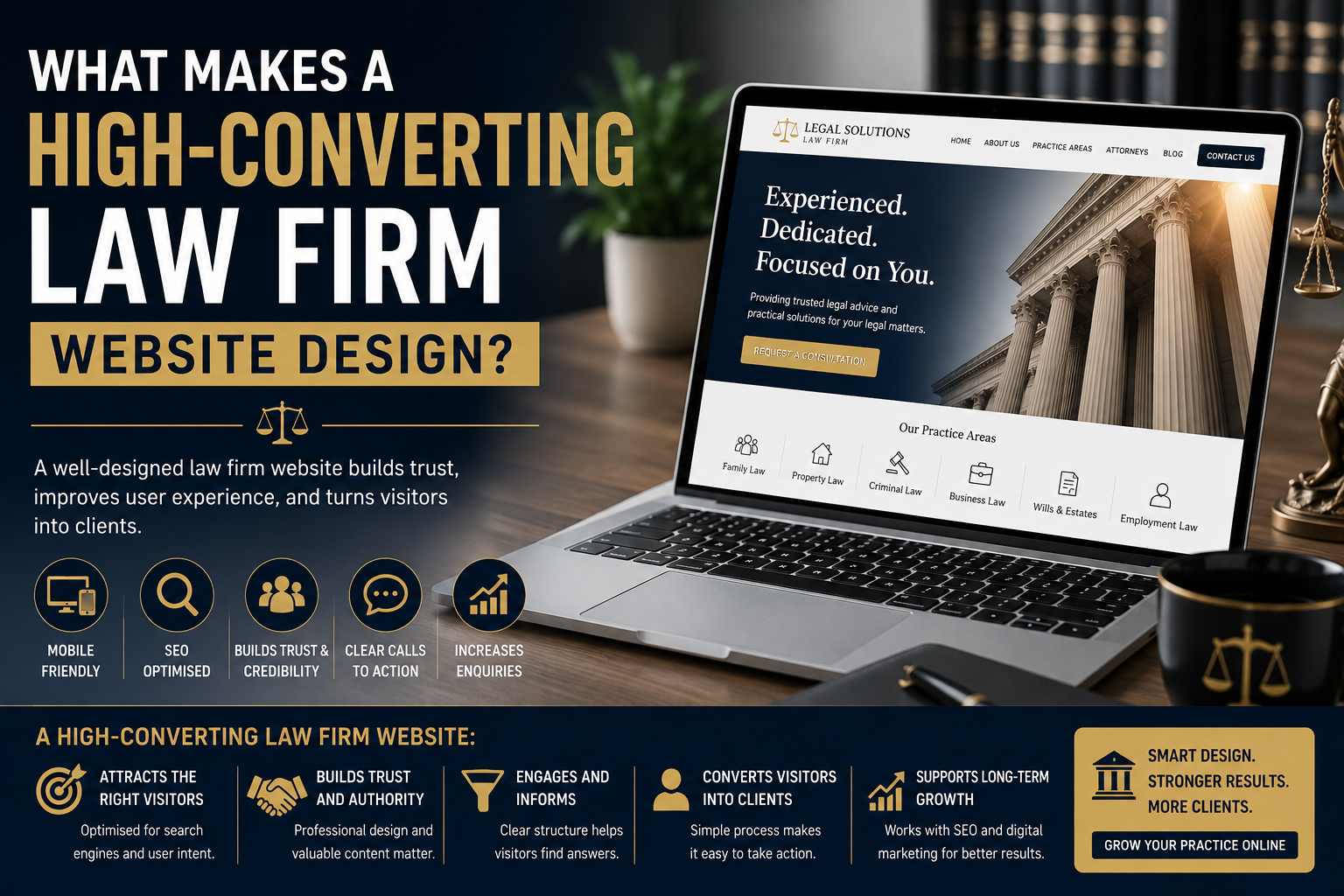
A law firm website should do more than present information about legal services. It should help visitors understand the firm, find answers to their questions, build confidence, and take the next step towards making an enquiry.
For Australian legal practices, a well-planned law firm website design can become an important part of attracting new clients. When the website is combined with useful content, search visibility, and an effective online marketing strategy, it can support consistent growth and stronger digital presence.
But what actually makes a legal website convert visitors into potential clients? The answer involves much more than colours, images, and layouts.
What Is a High-Converting Law Firm Website?
A high-converting website is designed around what visitors need to know and what the firm wants them to do.
For a law firm, this could mean encouraging visitors to:
- Call the office
- Submit an enquiry
- Request a consultation
- Book an appointment
- Learn more about a particular legal service
- Contact a specific lawyer or team
A successful website removes unnecessary barriers between the visitor and the action they want to take.
It should also communicate the firm's services clearly enough that a potential client can quickly determine whether the practice is suitable for their legal matter.
1. A Clear and Strong First Impression
The homepage is often one of the first pages a potential client sees.
Within a few seconds, visitors should be able to understand:
- What type of law the firm handles
- Who the firm assists
- Where the firm operates
- What makes the practice different
- How to get in touch
A cluttered homepage can make it difficult for visitors to understand what the firm offers.
Instead, the page should use clear headings, concise messaging, relevant imagery, and straightforward navigation.
The goal is not to fill the screen with information. It is to make important information easy to understand.
2. Easy Navigation
Legal websites can contain a large amount of information, particularly when a firm offers multiple areas of practice.
Visitors should not have to search through several pages to find a service or contact option.
A logical navigation structure might include:
- Home
- About
- Our Lawyers
- Practice Areas
- Resources
- Contact
Practice areas can then be organised into individual pages.
For example, a firm may have separate pages for family law, property law, commercial law, employment law, estate planning, or litigation.
Good navigation improves the user experience and helps search engines understand how the website is structured.
3. Dedicated Legal Service Pages
One of the most important elements of an effective legal website is the quality of its service pages.
A generic page listing ten different legal services may not provide enough information for someone looking for help with a specific issue.
Instead, individual practice areas should explain:
- What the service involves
- What types of matters the firm handles
- Who may need the service
- Common questions clients ask
- How the firm can assist
- What the next step should be
Dedicated pages can also create additional opportunities to target relevant search queries.
This is where SEO for lawyers can work closely with website structure and content strategy.
4. Strong Calls to Action
A visitor may be interested in a firm's services but still leave the website if there is no obvious next step.
Calls to action guide visitors towards an appropriate action.
Examples include:
Request a Consultation
Speak With Our Legal Team
Make an Enquiry
Call Our Office
Discuss Your Legal Matter
These calls to action should be visible without becoming intrusive.
A good website makes it easy for visitors to contact the firm whenever they are ready.
5. Mobile-Friendly Design
Many potential clients use smartphones when searching for legal services.
A website that looks good on a desktop but performs poorly on mobile can create unnecessary friction.
A mobile-friendly legal website should have:
- Responsive layouts
- Readable text
- Easy-to-use menus
- Clearly visible contact buttons
- Mobile-friendly forms
- Properly sized images
- Fast-loading pages
The entire enquiry process should work smoothly on smaller screens.
Mobile usability is therefore an important part of creating a website that is accessible to potential clients wherever they are searching.
6. Trust-Building Content
Legal services involve important personal, financial, and business decisions. Visitors naturally want to know whether they can trust the firm they are considering.
A website can support this decision by providing useful information about:
- The firm's lawyers
- Areas of practice
- Experience and qualifications
- Office locations
- Client-focused approach
- Legal resources
- Relevant memberships or recognitions where appropriate
Lawyer profile pages can also help put a human face behind the firm.
Rather than relying only on promotional claims, websites should provide genuine information that helps visitors understand who they may be working with.
7. Useful and Relevant Content
Content can play a major role in both user experience and search visibility.
Potential clients often search Google with questions before they are ready to contact a lawyer.
For example:
- How does property settlement work?
- What happens after receiving an employment dispute?
- How long does a divorce take?
- When should I speak to a commercial lawyer?
- What should I know before signing a business contract?
Creating helpful resources around these questions can bring relevant visitors to the website.
The content should be written for people first rather than simply created to insert keywords.
When information is useful, clear, and relevant, visitors are more likely to continue exploring the website.
8. Search-Friendly Website Structure
A beautiful website is not enough if potential clients cannot find it.
Search visibility should be considered from the beginning of the website planning process.
Important areas include:
- Page titles
- Headings
- Internal linking
- URL structure
- Relevant content
- Image optimisation
- Mobile usability
- Website speed
- Technical accessibility
- Local search relevance
A well-organised website gives search engines a clearer understanding of the firm's services and the topics covered on each page.
This can create a stronger foundation for ongoing organic search efforts.
9. Local SEO for Australian Law Firms
Legal services are often connected to specific locations.
A person searching for a lawyer may include a city, suburb, or region in their search.
For example:
- family lawyer Melbourne
- property lawyer Sydney
- commercial lawyer Brisbane
- employment lawyer Perth
A law firm's website should clearly communicate its service areas and locations.
Location pages and locally relevant content can help firms connect with people searching for legal services in their target areas.
Accurate contact information and consistent business details are also important for building a trustworthy local presence.
10. Fast Website Performance
Website speed can influence both user experience and conversions.
If a page takes too long to load, a visitor may leave before reading the content or contacting the firm.
Several factors can affect website performance, including large images, unnecessary scripts, poor hosting, and inefficient website code.
A high-converting website should therefore be designed with performance in mind.
Images should be appropriately optimised, pages should avoid unnecessary elements, and technical issues should be identified and addressed.
11. Simple Contact Forms
Contact forms are one of the most important conversion points on a legal website.
However, forms that ask for too much information can discourage visitors from completing them.
A simple enquiry form might request only essential details such as:
- Name
- Phone number
- Type of legal matter
- Brief message
The exact fields should depend on the firm's requirements.
The important point is to keep the process straightforward while collecting enough information for the firm to respond appropriately.
12. Consistent Branding
A law firm's website should reflect a consistent brand identity.
Fonts, colours, imagery, messaging, logos, and design elements should work together across the website.
Consistency helps visitors recognise the firm and creates a more organised online experience.
The design should also suit the firm's audience. A corporate law practice may require a different visual approach from a family law practice, while both should prioritise clarity and usability.
13. Integration With Digital Marketing
A website becomes even more valuable when it works as part of a broader marketing strategy.
Digital marketing for lawyers can include search engine optimisation, content marketing, social media, email marketing, online reputation management, and paid advertising.
The website can act as the central destination for these activities.
For example, a person may discover a firm through an online advertisement, read an educational article, explore a service page, and then submit an enquiry.
If all these touchpoints lead to a well-designed website, the firm's marketing efforts have a stronger opportunity to turn attention into enquiries.
14. Analytics and Conversion Tracking
A law firm should not have to guess whether its website is working.
Analytics and conversion tracking can provide useful information about how visitors interact with the website.
Firms can monitor metrics such as:
- Website traffic
- Popular service pages
- Traffic sources
- Contact form submissions
- Phone interactions where tracking is available
- User engagement
- Landing page performance
This information can reveal which areas are performing well and where improvements may be needed.
Website optimisation should be an ongoing process rather than a one-time project.
15. Regular Improvements Matter
Online behaviour changes, search technology evolves, and competitors continue improving their websites.
A website that worked well several years ago may not provide the same experience today.
Law firms should periodically review their:
- Website content
- Practice area pages
- Mobile experience
- Contact process
- Search visibility
- Page speed
- Calls to action
- Local information
Small improvements can make the website easier to use and more effective at converting visitors.
How SEO, Website Design and Marketing Work Together
The strongest online presence does not depend on one individual strategy.
Law firm website design provides the foundation. It creates the structure and user experience through which visitors interact with the firm.
SEO for lawyers helps improve the website's ability to appear when potential clients search for relevant legal services and information.
Digital marketing for lawyers expands the firm's reach through multiple online channels and brings different types of visitors back to the website.
When these elements work together, a law firm can create a more connected digital journey:
Search or marketing channel → Website → Relevant information → Trust → Enquiry
This approach focuses on the entire client journey rather than treating website design and marketing as separate activities.
Final Thoughts
A high-converting legal website is built around clarity, trust, usability, and accessibility. It should help potential clients quickly understand what the firm offers, find relevant information, and take the next step when they are ready.
The key is to focus on the people visiting the website. When design, content, search visibility, and conversion opportunities work together, a legal website has a much better chance of turning online attention into meaningful enquiries.

 English
 Arabic
 Spanish
 Portuguese
 Deutsch
 Turkish
 Dutch
Dutch
 Italiano
 Russian
 Romaian
 Portuguese (Brazil)
 Greek
Greek