


Private Label Supplement Manufacturing: From Capsules to Gummies, Teas & Powders
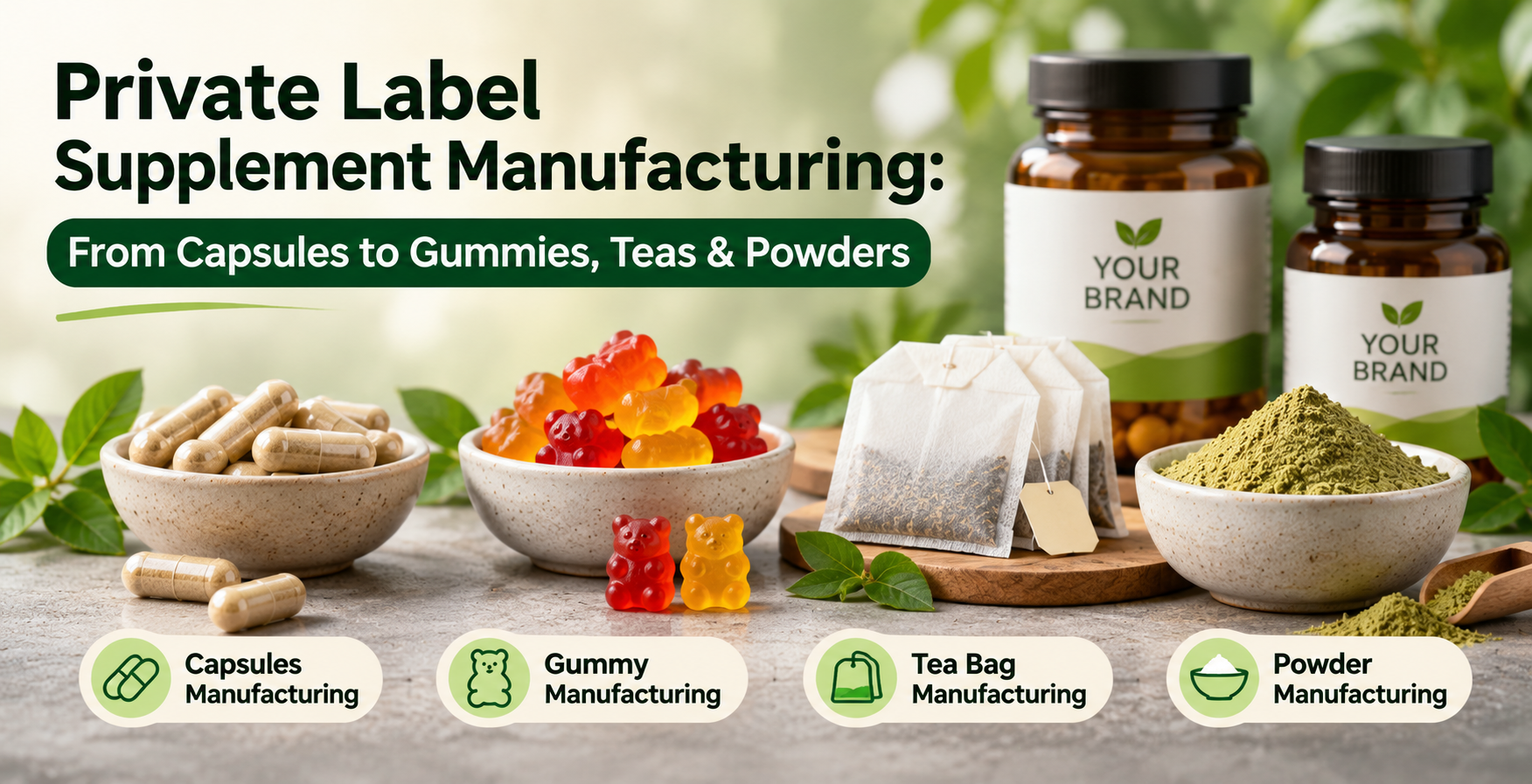
Launching a supplement brand takes more than choosing attractive packaging. Customers expect convenient products, consistent quality, transparent ingredients, and trustworthy information. Private label supplement manufacturing helps businesses introduce products under their own brand while working with an established production partner. Instead of building a factory, brands can focus on positioning, customer experience, and distribution. This guide explains how the process works, compares capsules, gummies, tea bags, and powders, and outlines the questions to ask before placing your first order.
What Is Private Label Supplement Manufacturing?
Private label supplement manufacturing is an arrangement in which a manufacturer produces products sold under another company's brand. Some partners offer ready-made formulas that can be packaged with custom labels. Others provide formulation development, ingredient sourcing, flavor adjustments, testing, packaging, and fulfillment support.
This approach can reduce the operational burden of owning production equipment, but it does not remove the brand owner's responsibilities. Businesses must understand their target market, assess product safety, review label claims, and confirm the manufacturer can consistently meet agreed specifications.
How the Manufacturing Process Works
A successful project usually begins with a product brief describing intended customers, ingredients, serving format, packaging, target price, and launch quantity. The manufacturer then reviews feasibility, ingredient availability, minimum order quantities, and estimated production timelines.
Next come formulation or formula selection, samples, stability considerations, and packaging approval. Once specifications are finalized, production proceeds through documented manufacturing controls, testing, and release procedures. Clear communication throughout these stages helps avoid expensive changes after production begins.
Capsules Manufacturing: Familiar and Practical
Capsules manufacturing suits brands seeking portable, measured servings without added flavors. Capsules may contain powdered botanicals, vitamins, minerals, or other suitable ingredients, depending on the formulation. Shell materials, fill weights, ingredient compatibility, and capsule sizes all influence the finished product.
Manufacturers typically blend ingredients, fill capsule shells, check weight consistency, and package finished units. Quality checks should address identity, composition, contamination risks, and other relevant specifications. Brands should also discuss vegetarian capsule options, moisture sensitivity, and packaging that protects ingredients during storage.
Capsules can be straightforward to use, but they are not ideal for every ingredient or customer preference. Serving size and swallowing comfort deserve consideration.
Gummy Manufacturing: Appealing but Complex
Gummy manufacturing offers an approachable format for consumers who dislike swallowing capsules. Colors, flavors, textures, and shapes create opportunities for product differentiation. However, taste and appearance must never overshadow appropriate ingredient levels or reliable quality.
Developing gummies requires attention to sweeteners, gelling agents, acidity, ingredient stability, and uniform distribution. Some active ingredients may introduce bitterness or react poorly during processing. Heat exposure, moisture control, and shelf-life testing are therefore important discussion points.
Ask prospective partners about available gummy bases, sugar-free options, allergen controls, packaging barriers, and how they confirm serving consistency. Realistic formulation choices are more valuable than ambitious ingredient lists that cannot remain stable.
Tea Bag Manufacturing: Convenience Meets Ritual
Tea bag manufacturing works well for brands offering botanical infusions and wellness-focused beverages. Manufacturers may source dried herbs, cut and sift ingredients, blend recipes, fill filter bags, and pack individual sachets or cartons.
Unlike capsules, tea bags are prepared through steeping, so the amount of a compound extracted into water can vary. Ingredient particle size, blend consistency, brewing instructions, and moisture protection all affect the customer experience.
Check the intended product classification and labeling requirements in each sales market. Not every herbal tea is legally a dietary supplement. A knowledgeable partner can help brands understand practical formulation and packaging differences without promising unsupported health outcomes.
Powder Manufacturing: Flexible Serving Options
Powder manufacturing supports products intended for mixing into water, smoothies, or other foods. Popular applications include protein blends, greens, fiber products, and botanical powders. Powders offer flexibility in serving size and flavor, although achieving good dispersibility can be challenging.
Production may involve ingredient screening, blending, particle-size management, filling, and sealing. Manufacturers should evaluate blend uniformity, moisture exposure, clumping, flavor compatibility, and packaging integrity. Single-serving sachets can offer portability, while tubs or pouches may suit regular use.
Discuss scoop accuracy, instructions, and potential settling during transport. Clear preparation guidance improves usability and reduces confusion for first-time customers.
Quality, Compliance, and Labeling
Product quality should guide every manufacturing decision. Request information about ingredient verification, supplier qualification, batch documentation, relevant contaminant testing, and finished-product release. Ask what certificates of analysis actually cover and whether independent testing is available.
For supplements marketed in the United States, manufacturers must follow applicable current good manufacturing practice requirements, including 21 CFR Part 111. The FDA generally does not approve dietary supplements before sale. Brand owners remain responsible for lawful labeling and truthful, substantiated claims. Requirements differ across countries and product categories, so obtain qualified regulatory guidance before launch.
Choosing the Right Manufacturing Partner
Compare manufacturers on more than price. Ask whether they handle your chosen dosage form in-house, provide meaningful samples, explain testing procedures, and communicate realistic timelines. Clarify minimum order quantities, setup fees, ingredient substitutions, packaging costs, and responsibility for rejected batches.
Request written agreements covering formula ownership, confidentiality, quality expectations, change approvals, and complaint handling. A partner who can explain limitations openly is often more valuable than one who promises every feature immediately.
Frequently Asked Questions
Can startups use private label manufacturing? Yes, although minimum order quantities and development costs vary by partner and product format.
Which format should a new brand choose? Start with audience preferences, ingredient suitability, desired price, and stability requirements rather than following trends alone.
Are custom formulas necessary? No. Existing formulas may simplify development, while custom formulations offer differentiation but usually require additional evaluation.
Final Thoughts
Private label supplement manufacturing can help brands turn a product concept into a commercial offering without operating their own factory. Capsules, gummies, teas, and powders each involve different manufacturing challenges and customer expectations. Thoughtful planning also helps avoid delays, waste, and unnecessary reformulation costs. By prioritizing responsible formulation, documented quality systems, accurate labels, and reliable communication, businesses can build a foundation for a credible supplement brand and sustainable growth.

 English
 Arabic
 Spanish
 Portuguese
 Deutsch
 Turkish
 Dutch
 Italiano
 Russian
 Romaian
 Portuguese (Brazil)
 Greek