


Inventory Management Systems for Ethiopian Pharmaceutical Importers
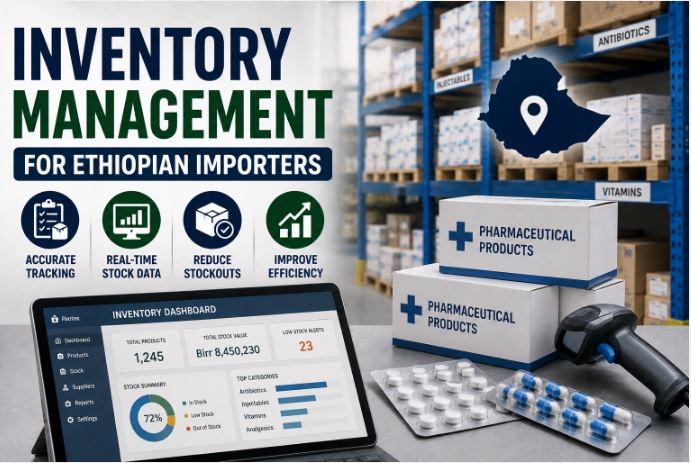
In the pharmaceutical industry, having enough medicines in stock is just as important as manufacturing high-quality products. A hospital cannot treat patients if essential medicines are unavailable, and a distributor cannot serve pharmacies effectively if inventory records are inaccurate. For pharmaceutical importers in Ethiopia, inventory management has become one of the most important factors in maintaining business profitability while ensuring uninterrupted access to healthcare products.
As Ethiopia's pharmaceutical market continues to grow, importers handle thousands of medicine batches across multiple therapeutic categories. Managing these products manually is becoming increasingly difficult. From tracking expiry dates to forecasting demand and maintaining regulatory compliance, modern inventory management systems provide businesses with the tools they need to operate efficiently.
An effective inventory management system is not simply software—it is a complete strategy that helps pharmaceutical businesses maintain the right medicines in the right quantities at the right time.
Why Inventory Management Matters in Pharmaceutical Distribution
Unlike many other industries, pharmaceutical inventory involves products that have limited shelf lives, strict storage requirements, and extensive regulatory documentation.
Every medicine stored inside a warehouse represents both an investment and a responsibility. Poor inventory management can quickly lead to product shortages, expired medicines, financial losses, and dissatisfied healthcare providers.
For Ethiopian pharmaceutical importers, efficient inventory management offers several important benefits:
- Better medicine availability
- Reduced product expiry
- Lower storage costs
- Improved cash flow
- Faster order fulfillment
- Greater inventory accuracy
- Stronger regulatory compliance
Businesses that understand their inventory in real time can make better purchasing and distribution decisions.
Challenges Faced by Ethiopian Pharmaceutical Importers
Importing medicines into Ethiopia involves much more than placing international purchase orders.
Businesses must coordinate manufacturing schedules, export documentation, customs clearance, transportation, warehousing, and nationwide distribution.
Throughout this process, inventory can be affected by several factors, including:
- Long international shipping times
- Customs processing delays
- Foreign exchange constraints
- Seasonal demand fluctuations
- Product registration timelines
- Temperature-sensitive storage requirements
- Limited warehouse capacity
Without a structured inventory management system, these challenges become much more difficult to control.
Moving Beyond Manual Inventory Tracking
Many growing businesses begin with spreadsheets or handwritten inventory records.
While these methods may work for small operations, they quickly become inefficient as product volumes increase.
Manual inventory systems often lead to:
- Data entry mistakes
- Duplicate orders
- Missing stock records
- Delayed reporting
- Difficulty tracking expiry dates
- Slow order processing
Modern inventory management software eliminates many of these issues by providing accurate, real-time information across the business.
Employees can instantly verify stock availability without physically checking warehouse shelves.
Real-Time Inventory Visibility
One of the greatest advantages of digital inventory systems is real-time visibility.
Managers can immediately access information such as:
- Available stock
- Reserved inventory
- Incoming shipments
- Batch numbers
- Expiry dates
- Warehouse locations
- Product movement history
This visibility improves decision-making throughout purchasing, warehousing, and sales operations.
Instead of reacting to inventory problems after they occur, businesses can identify potential shortages before they affect customers.
Demand Forecasting Improves Purchasing Decisions
One common reason for inventory problems is inaccurate demand forecasting.
Ordering too much inventory increases warehouse costs and creates expiry risks.
Ordering too little results in medicine shortages and lost sales.
Modern inventory management systems analyze historical sales data together with seasonal demand patterns to generate more accurate purchasing forecasts.
For example, medicines used to treat respiratory infections may experience increased demand during colder months, while certain chronic disease medicines maintain relatively stable demand throughout the year.
Better forecasting helps importers maintain balanced inventory levels while improving cash flow.
Batch Tracking Supports Product Safety
Pharmaceutical products must remain fully traceable throughout the supply chain.
Every batch entering a warehouse should be tracked from receiving until final distribution.
Inventory management systems record important information including:
- Batch numbers
- Manufacturing dates
- Expiry dates
- Supplier details
- Storage location
- Customer deliveries
If a product recall becomes necessary, businesses can quickly identify affected inventory and notify customers.
This traceability strengthens both regulatory compliance and patient safety.
FEFO Inventory Rotation Reduces Waste
Unlike many retail products, medicines should not simply be distributed according to the order in which they were received.
Instead, pharmaceutical warehouses generally follow the First Expiry, First Out (FEFO) principle.
Inventory systems automatically identify products approaching expiry and prioritize them during order processing.
This approach helps reduce:
- Product wastage
- Financial losses
- Emergency product disposal
- Stock write-offs
Even small improvements in inventory rotation can significantly improve profitability.
Warehouse Integration Creates Greater Efficiency
Modern inventory systems integrate closely with warehouse operations.
Instead of manually searching for products, warehouse staff receive digital picking instructions showing:
- Product location
- Quantity required
- Batch number
- Expiry information
Barcode scanning further improves accuracy during:
- Receiving shipments
- Stock transfers
- Order picking
- Dispatch
- Inventory audits
Automation reduces human error while increasing warehouse productivity.
Temperature-Sensitive Inventory Requires Additional Monitoring
Many imported pharmaceutical products require controlled storage conditions.
Vaccines, biologics, insulin, and injectable medicines must remain within specified temperature ranges throughout storage.
Advanced inventory systems can integrate with environmental monitoring equipment to provide:
- Temperature records
- Cold room monitoring
- Alarm notifications
- Compliance reports
This integration improves quality assurance while simplifying regulatory documentation.
Inventory Audits Maintain Accuracy
No inventory system remains accurate without regular verification.
Routine inventory audits help identify discrepancies between physical stock and digital records.
Common audit activities include:
- Cycle counting
- Full warehouse inventory checks
- Batch verification
- Expiry inspections
- Damaged product identification
Frequent audits improve data accuracy while reducing unexpected inventory losses.
Businesses should treat inventory verification as an ongoing process rather than an annual exercise.
Regulatory Compliance Becomes Easier
Pharmaceutical regulators require businesses to maintain accurate inventory records.
Digital systems simplify compliance by automatically generating documentation such as:
- Batch histories
- Stock movement reports
- Temperature records
- Expiry reports
- Distribution records
- Inventory reconciliation reports
Organized documentation supports inspections while demonstrating strong quality management practices.
Improving Cash Flow Through Better Inventory Control
Inventory represents one of the largest financial investments for pharmaceutical importers.
Excess inventory ties up working capital.
Insufficient inventory reduces sales opportunities.
Effective inventory management helps businesses maintain optimal stock levels by balancing customer demand with purchasing costs.
Benefits include:
- Lower storage expenses
- Reduced expired stock
- Faster inventory turnover
- Better purchasing decisions
- Improved financial planning
Healthy inventory management contributes directly to stronger profitability.
Technology Is Transforming Pharmaceutical Inventory Management
Digital transformation continues reshaping pharmaceutical logistics across Africa.
Today's inventory systems increasingly include:
- Cloud-based inventory management
- Mobile warehouse applications
- Barcode technology
- RFID product tracking
- Artificial intelligence demand forecasting
- Automated purchase recommendations
- Business intelligence dashboards
These technologies provide greater visibility across the entire supply chain.
Managers can monitor inventory performance from virtually anywhere while making faster, data-driven decisions.
Training Employees Is Just as Important as Software
Installing inventory software alone does not guarantee success.
Employees must understand how to use the system correctly.
Training should include:
- Receiving procedures
- Barcode scanning
- Stock transfers
- Batch tracking
- Inventory adjustments
- Reporting
- Quality documentation
Consistent operating procedures help maintain inventory accuracy across every department.
Well-trained employees become valuable contributors to overall supply chain performance.
Planning for Business Growth
As pharmaceutical businesses expand, inventory systems should grow with them.
Scalable systems allow importers to manage:
- Multiple warehouses
- Additional product categories
- Regional distribution centers
- Larger customer networks
- Increased shipment volumes
Planning ahead reduces the need for costly system replacements as operations expand.
Businesses investing in modern inventory systems today position themselves for sustainable future growth.
Choosing a Reliable Pharmaceutical Manufacturing Partner
Inventory efficiency begins long before products arrive in Ethiopia. Working with a dependable pharmaceutical manufacturer helps ensure consistent production schedules, accurate documentation, reliable packaging, and predictable delivery timelines.
Experienced manufacturing partners support importers by maintaining high-quality standards, providing complete regulatory documentation, and coordinating efficient export operations.
For pharmaceutical businesses looking to strengthen their supply chain, Vo Pharma offers comprehensive pharmaceutical manufacturing and export services backed by international quality standards. Their experience in serving global markets helps importers source reliable medicines while simplifying procurement and logistics. Learn more at https://vopharma.in/africa/pharma-exporter-to-ethiopia/.
The Future of Inventory Management in Ethiopia
Ethiopia's pharmaceutical market will continue evolving as healthcare demand increases and digital technologies become more accessible.
Future inventory management systems are expected to include:
- AI-powered demand forecasting
- Predictive inventory analytics
- Internet of Things (IoT) warehouse monitoring
- Automated replenishment systems
- Blockchain-based product traceability
- Greater integration with national healthcare supply chains
Businesses that adopt these technologies early will gain stronger operational efficiency and greater resilience in an increasingly competitive market.
Conclusion
Efficient inventory management is one of the most valuable investments Ethiopian pharmaceutical importers can make. It helps ensure medicines remain available, reduces waste, improves regulatory compliance, strengthens customer service, and supports sustainable business growth.
By replacing manual processes with modern inventory management systems, businesses gain real-time visibility, improve forecasting, simplify warehouse operations, and make more informed purchasing decisions. Combined with reliable manufacturing partners and efficient logistics, these systems create a stronger and more dependable pharmaceutical supply chain.
As Ethiopia's healthcare sector continues to expand, companies that prioritize inventory excellence will be better equipped to meet growing demand, reduce operational risks, and deliver high-quality medicines to healthcare providers and patients across the country.

 Arabic
 French
 Spanish
 Portuguese
 Deutsch
 Turkish
 Dutch
Dutch
 Italiano
 Russian
 Romaian
 Portuguese (Brazil)
 Greek
Greek