


Does Oracle HCM Training Online Cover Real Implementation Scenarios or Only Demos?
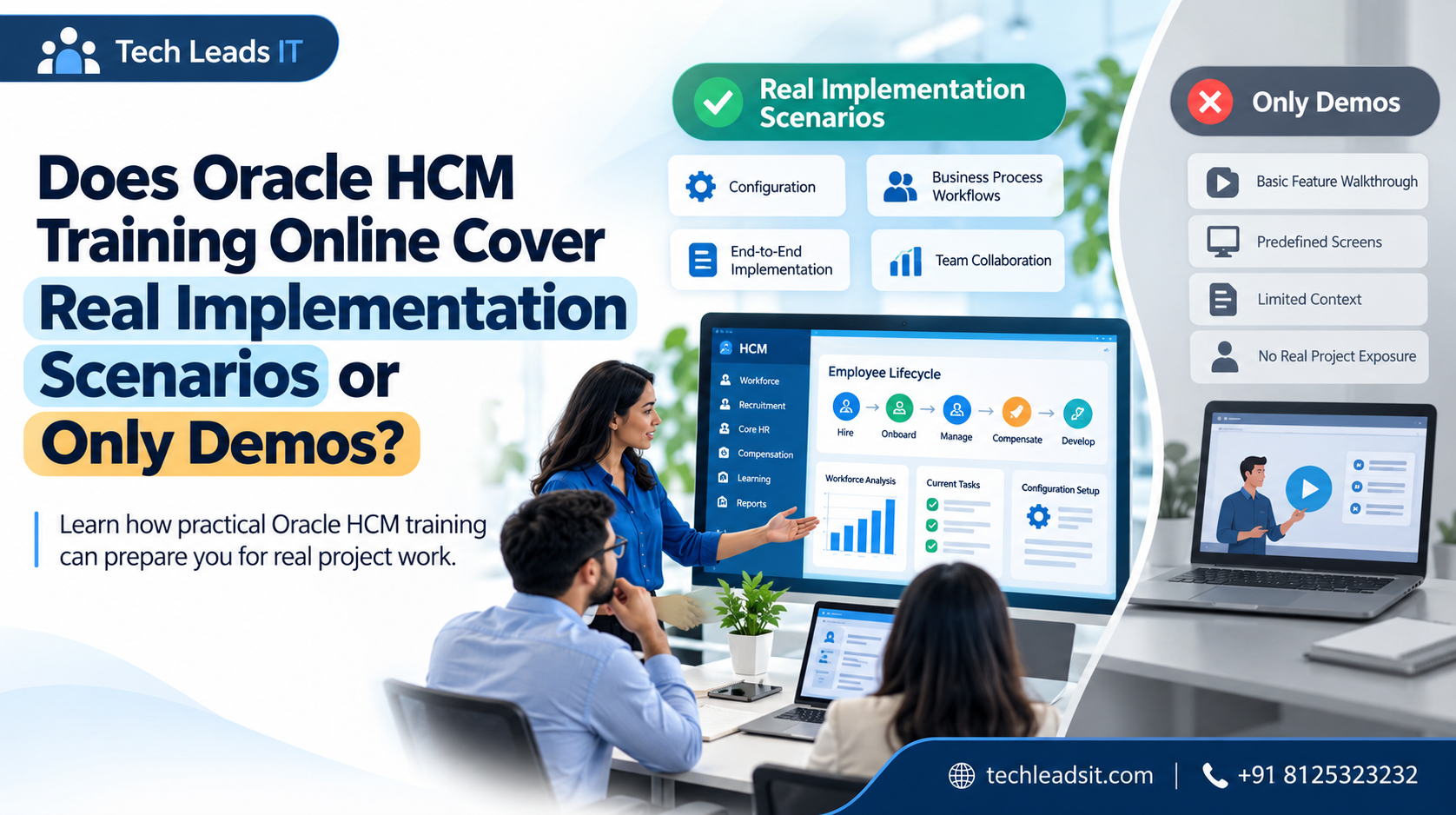
Two learners can sit through the same hire-an-employee lesson and walk away with very different skills. Tech Leads IT gets this question from learners all the time: one watched a clean demo, the other had to fix a record that broke halfway through, and from outside both courses look identical.
If you're weighing Oracle HCM Training Online, the real question isn't "Is there practical content?" Almost every provider says yes. It's whether the practice resembles a project or only a presentation. This guide shows the difference, lists the scenarios a project-style course should include and gives you ways to test a provider before paying.
Same Screen, Different Lesson
A demo answers "how do I do this?" in perfect conditions. The data is clean, the dates make sense, the approver exists and nothing goes wrong.
A scenario answers "what do I do when this happens?" It starts with a business situation, adds a complication and asks you to decide.
Picture a hire. In a demo, the trainer creates an employee and moves on. In a scenario, the manager says the new joiner's start date is next Monday, the offer was approved last week, but the job doesn't exist yet in the system and the department head wants the person to report to someone on leave. Now you must create the job, pick an approver and decide what to do about the reporting line. The clicks are identical. The thinking is entirely different, and thinking is what clients pay consultants for.
Why Demos Alone Leave a Gap
Demos have a place. They introduce a screen and show the happy path quickly. Trouble starts when a course stops there, because learners then discover three problems at their first interview or first job:
-
They can repeat steps but can't explain why those steps exist.
-
They freeze when a transaction fails, since they've never seen a failure.
-
They have nothing concrete to say when asked, "Tell me about a problem you solved."
Interviewers for consultant roles tend to probe exactly this. A candidate who has only watched demos struggles to answer scenario questions, and it usually shows within minutes.
Seven Scenarios a Project-Style Course Should Include
Each one works like a small case study, and since names and menus differ between releases, judge the situations rather than the labels.
1. A wrongly dated change. An employee's transfer was entered with the wrong effective date, and a payroll run has already happened. What gets corrected, in what order, and who needs to know?
2. A reorganisation. Two departments merge and a manager hierarchy changes for dozens of people. How do you update it without breaking approvals or reports?
3. A leave policy with exceptions. Full-time staff accrue leave monthly, part-timers differently, and mid-year joiners get a pro-rated entitlement. Build it, then explain it to a sceptical HR manager.
4. A bulk data load that fails. A file of 500 employee records loads, and 40 reject. You read the error report, find a pattern and fix the source data.
5. An approval chain that stalls. A manager leaves the company with requests pending. How do you reroute without losing history?
6. A payroll result that looks wrong. A deduction appears twice in a trial run. Where do you start looking, and how do you prove the cause?
7. A quarterly update. Oracle ships changes on a schedule. A feature your client relies on behaves differently. How do you test, document and warn the client?
If a syllabus or trainer can't describe at least a few of these, the course probably stays closer to demonstration than to implementation.
What a Scenario-Based Class Feels Like
You can often sense the difference within one session.
-
The trainer begins with a business problem, not a menu path.
-
Learners are asked to predict what will happen before clicking.
-
Mistakes are treated as material. Someone deliberately enters a wrong date or a missing approver to see the result.
-
The trainer shares stories from live projects, including what went wrong.
-
Homework looks like a mini case: "Configure this policy for a fictional company and write down your choices."
-
You're asked to explain, not only to perform.
By contrast, a demo-heavy class feels like watching someone cook. You see a finished dish, but you've never held the pan.
Why Some Courses Stay With Demos
It helps to understand the reasons, so you can judge fairly and not assume bad intent.
Time pressure. Scenarios take longer to teach than screens do. A short course may pack in more topics by showing each one briefly.
Practice environment limits. Giving every learner a hands-on instance costs money and takes effort. Some providers share one screen instead.
Trainer background. Someone who has taught for years but never worked on a live project may lack stories to build scenarios from.
Marketing pressure. A long module list sells better than a short list of deep scenarios.
None of these makes a provider dishonest. They do show up in your outcome, so it's worth asking directly.
Five Ways to Test a Provider Before You Pay
Use a demo or counselling session to run a small test.
1. Ask for a scenario, not a feature. Say: "Show me what happens if a transfer is entered with the wrong effective date." Watch whether the trainer handles it comfortably or changes the subject.
2. Ask what went wrong on their last project. A trainer with real implementation experience has a story ready. Listen for specifics: the module, the mistake, the fix.
3. Ask whether you get your own practice login. Learning by watching someone else's screen is slow. Find out how long access lasts after the course.
4. Ask for the final project outline. A good course ends with a connected exercise, such as following one employee from hire through leave, pay and review. A vague answer is a warning.
5. Ask how mistakes are used in class. If the answer is "We avoid errors so students don't get confused," the course is built for smooth demos. If the answer is "We introduce errors on purpose," you're closer to project work.
What a Strong Answer Sounds Like
Compare two replies to the question "Do you teach real scenarios?"
Weak: "Yes, we cover real-time projects and live scenarios in every module."
Strong: "Yes. For example, in Absence we give you a company with three employee groups and different accrual rules, and you configure it. Then we introduce a mid-year joiner and a carry-over limit and ask you to fix your design. You document your choices and we review them."
The second reply names a situation, a complication and a deliverable. The first only repeats the claim.
If Your Course Turns Out to Be Demo-Heavy
Sometimes you notice the gap after enrolling. You can still close it yourself.
-
Re-run every demo with a twist. After a lesson, repeat it with a different date, a different manager or an invalid input.
-
Invent a fictional company. Write its policies on one page and configure as much as your practice environment allows.
-
Keep an error log. Note every failure, its cause and its fix. After a month, it becomes a personal reference and a source of interview stories.
-
Ask your trainer for a case. Many are glad to supply one when learners request it.
-
Practise explaining. Describe a setup choice aloud as if to a non-technical HR manager.
These habits turn a demo course into something closer to a project course.
Honest Limits
No training course replaces live project work. Even the best scenario-based programme can only imitate the pressure of a client deadline or the messiness of a real company's data. What a good course does is make your first project less of a shock, giving you a head start and a vocabulary for talking about problems.
Be wary of anyone who says a course equals project experience. A fair promise is realistic practice, and the rest comes on the job.
How to Compare Providers
When you shortlist options, compare how Fusion HCM Cloud Online Training and Fusion HCM Online Training programmes describe their practice work. Look for named scenarios, a final project, your own practice login and a trainer who can discuss real implementations. A written case study from a past batch, with identifying details removed, is a good sign too, since it shows how the provider turns a business problem into a learning exercise.
The Bottom Line
A demo teaches you to follow steps. A scenario teaches you to handle a situation. Employers hire for the second skill, so your course should spend most of its time there. Test for it before you pay: ask for a failure, ask for a story, ask for the final project and ask whether you'll have your own environment.
When you're ready to choose, look for an Oracle Fusion HCM Course that practises realistic situations, lets you make mistakes safely and prepares you to explain your decisions in an interview. A course like that won't replace a project, but it will make your first one far less intimidating.

 English
 Arabic
 French
 Spanish
 Portuguese
 Deutsch
 Turkish
 Dutch
 Italiano
 Russian
 Romaian
 Greek