


Flue Gas Analyzer Market to Witness Steady Growth, Reaching US$ 1,194 Million by 2034
Fixed flue gas analyzers are used in industrial facilities that require continuous or frequent monitoring. These systems provide ongoing information about exhaust gas composition, helping operators identify emission variations and maintain process stability.
Flue Gas Analyzer Market Overview
The global flue gas analyzer market is witnessing steady growth due to increasing environmental regulations, rising awareness of air pollution, and the growing need for efficient combustion monitoring across industrial sectors. Flue gas analyzers are instruments used to measure the concentration of gases released during combustion processes. These devices help monitor emissions such as carbon monoxide (CO), carbon dioxide (CO₂), nitrogen oxides (NOx), and sulfur oxides (SOx), enabling businesses to improve combustion efficiency and comply with environmental standards.
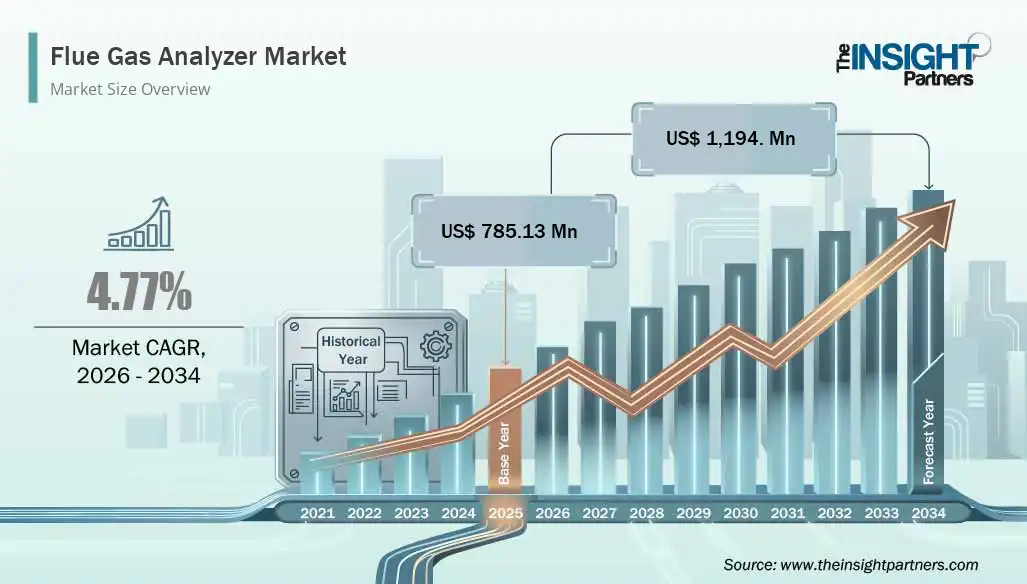
The global Flue Gas Analyzer market was valued at US$ 785.13 million in 2025 and is expected to reach US$ 1194 million by 2034. The market is estimated to record a CAGR of 4.77% during 2026–2034. Growing investments in industrial emission monitoring, energy efficiency, and pollution control technologies are expected to support market development throughout the forecast period.
Get a PDF Sample: https://www.theinsightpartners.com/sample/TIPRE00006218
Key Growth Drivers of the Flue Gas Analyzer Market
Increasing government regulations related to air quality and industrial emissions represent a major driver of the flue gas analyzer market. Manufacturing facilities, power plants, refineries, and other industrial establishments are under growing pressure to monitor and control harmful emissions. Flue gas analyzers provide accurate measurements that help operators assess emission levels, identify combustion inefficiencies, and maintain compliance with applicable environmental requirements.
The growing focus on energy efficiency is another important factor supporting market growth. By measuring oxygen levels and combustion gases, these instruments help operators optimize fuel consumption and improve the performance of boilers, furnaces, and industrial heating systems. Efficient combustion can reduce operating costs while limiting unnecessary emissions.
Technological advancements are also contributing to market expansion. Modern flue gas analyzers increasingly feature digital interfaces, automated data collection, wireless connectivity, and advanced sensor technologies. These capabilities improve measurement accuracy, simplify monitoring, and support preventive maintenance. Portable analyzers are particularly useful for field inspections, while fixed systems provide continuous monitoring in industrial environments.
Flue Gas Analyzer Market Segmentation Analysis
The flue gas analyzer market is segmented by type, technology, and application. By type, the market includes fixed and portable analyzers. Fixed analyzers are commonly installed in industrial facilities for continuous emission monitoring and process control. Portable analyzers are designed for inspections, maintenance activities, equipment testing, and on-site combustion analysis. Their mobility makes them suitable for technicians working across different industrial locations.
By technology, the market covers COx, NOx, and SOx measurement. COx monitoring helps assess combustion performance and identify potentially hazardous carbon monoxide concentrations. NOx measurement is important for evaluating nitrogen oxide emissions associated with combustion processes. SOx monitoring supports efforts to control sulfur oxide emissions, particularly in industries that use sulfur-containing fuels.
By application, the market includes small furnaces, maritime operations, industrial applications, and others. Small furnaces use analyzers to improve heating efficiency and combustion performance. Maritime applications require emission monitoring solutions to support compliance with applicable shipping and environmental requirements. Industrial applications represent an important segment because boilers, furnaces, power generation facilities, and manufacturing plants require reliable gas measurement for process optimization and pollution control.
Key Players in the Flue Gas Analyzer Market
Leading companies operating in the flue gas analyzer market focus on product innovation, measurement accuracy, monitoring capabilities, and global distribution. Key players include:
-
ABB Ltd.
-
California Analytical Instruments
-
Dragerwerk
-
Horiba
-
Kane International Limited
-
Nova Analytical Systems
-
Robert Bosch GmbH
-
Siemens AG
-
Testo AG
-
Thermo Fisher Scientific
These companies compete by developing advanced analytical instruments, expanding their product portfolios, and improving sensor performance. Investments in research and development, strategic partnerships, and customer support services also help market participants strengthen their competitive positions.
Future Outlook of the Flue Gas Analyzer Market
The future outlook for the flue gas analyzer market remains positive as industries continue to prioritize emission reduction, regulatory compliance, and operational efficiency. Increasing investments in industrial modernization and cleaner combustion technologies are expected to create opportunities for both fixed and portable analyzers.
Digital monitoring, remote diagnostics, automated reporting, and improved sensor technologies are likely to influence future product development. Demand may also benefit from the need to monitor emissions in power generation, manufacturing, maritime operations, and industrial heating systems.
However, market growth may be influenced by equipment costs, maintenance requirements, and variations in environmental regulations across regions. Manufacturers that offer reliable measurements, user-friendly systems, and cost-effective monitoring solutions are likely to strengthen their market positions.
Overall, the flue gas analyzer market is expected to expand steadily through 2034. Continued emphasis on air quality, energy efficiency, and industrial emission management will remain central to market development during the forecast period.
About The Insight Partners
The Insight Partners is a leading market research and consulting firm delivering actionable insights through in-depth industry analysis and strategic intelligence. The firm supports clients across various industries in making informed decisions by providing comprehensive market forecasts, competitive assessments, and growth opportunities.
Contact Us:
If you have any queries about this report or if you would like further information, please contact us:
Contact Person: Ankit Mathur
Email: [email protected]
Phone: +1-646-491-9876
Also Available in : Korean | German | Japanese | French | Chinese | Italian | Spanish

 Arabic
 French
 Spanish
 Portuguese
 Deutsch
 Turkish
 Dutch
Dutch
 Italiano
 Russian
 Romaian
 Portuguese (Brazil)
 Greek
Greek